Fort Lauderdale puts boat trailers on the road the way other cities put delivery trucks on theirs - frequently, unavoidably, and in numbers that catch new drivers off guard. Learning to drive here means trailer handling is not a bonus skill. It is part of driving.
Why Fort Lauderdale Drivers Encounter Boat Trailers More Than Almost Anywhere
The city's nickname is not marketing. Fort Lauderdale contains more than 160 miles of navigable canals within city limits, and across Greater Fort Lauderdale that network stretches past 300 miles - a figure that justifies the Venice of America label given to no other American city. Roughly 50,000 boats and yachts are registered to or berthed in the area. More than 2,000 superyachts pass through its waters every year.
Every trailered vessel means a truck-and-trailer combination on surface streets, at traffic lights, and in parking lots before it ever reaches the water. That volume peaks each October when the Fort Lauderdale International Boat Show arrives. The 2025 show drew more than 100,000 visitors, featured over 1,300 vessels from more than 50 countries, and generated close to two billion dollars in economic impact. During show week, the ramps and roads around Port Everglades handle trailer traffic that would be extraordinary anywhere else in the country.
Even on an ordinary Saturday, a new driver navigating Andrews Avenue or the road along the New River will encounter wide loads pulling out of canal-side driveways, trucks reversing toward ramps, and trailer tongues extending past stop lines. That exposure makes this worth understanding before you see it for the first time.
Does Your Florida Class E License Cover Towing a Boat Trailer?
A standard Florida Class E license covers towing a boat trailer in virtually every recreational situation. Florida does not require a separate endorsement for a personal vehicle towing a non-commercial trailer, provided the combined gross vehicle weight rating of the tow vehicle and trailer stays below the commercial threshold. Recreational boat trailers essentially never approach that line.
The commercial threshold is crossed when the combination exceeds a specific gross vehicle weight rating, or when the trailer alone is rated above a certain weight and the combination surpasses the commercial limit. A typical bass boat or center-console on a single-axle trailer loaded with fuel and gear falls well short. A large sport-fishing yacht on a heavy tandem-axle trailer could get closer - if you are moving something in that category, check the combined ratings against FLHSMV guidelines before driving.
For new and teen drivers, whatever restrictions apply to your license apply equally when towing. A learner's permit requires a licensed adult in the front seat. First-year nighttime and passenger restrictions do not disappear because a trailer is attached.
Florida Trailer Towing Laws Every Driver Must Know
Florida statute governs trailers separately from vehicles. Several rules apply specifically to towing and were never covered in standard driver's education.
- Trailer brakes. Florida law requires functioning brakes on every axle of a trailer once it exceeds a specific gross weight threshold. Most loaded boat trailers exceed that threshold. The current requirement is published at flhsmv.gov - it applies to gross weight, not the trailer's empty weight.
- Speed cap. Florida law sets a maximum towing speed lower than the standard interstate limit. Many trailer tire sidewall ratings are lower still. Drive at whichever limit is smaller - check the tire sidewall and your tow-vehicle owner's manual for the applicable figures.
- One trailer only. Towing more than one trailer at a time is prohibited. A boat trailer and a jet-ski trailer behind it counts as two - illegal regardless of combined weight.
- Drawbar length. The connection between tow vehicle and trailer has a maximum legal length. If you use an extension hitch to clear a rear-mounted spare tire or step bumper, measure the total before you drive.
- Safety chains. Chains must be strong enough to hold the trailer if the hitch fails, and must be crossed under the trailer tongue in an X pattern. That crossing forms a cradle that catches the tongue if the coupler separates. Straight chains skip that protection entirely.
Width, Length, and Overhang Rules for Boat Trailers
For most single-engine boats on standard trailers, neither a width permit nor an overhang flag will ever apply. For wider boats - catamarans, large pontoons, certain center-consoles - the beam measurement matters before the rig leaves the driveway.
When a boat's beam exceeds Florida's width threshold, the combination is over-dimensional. An over-dimensional permit from the Florida Department of Transportation is required before moving on a public road. That permit specifies approved routes and may restrict travel to certain hours. Check fdot.gov for the current width threshold and the permit application process.
Florida law also limits how far a load can project beyond the rear of the trailer frame. Anything protruding beyond that rear point during daylight must be marked with a red or orange flag of proper size at the rearmost point of the overhang. After dark, a red lamp visible from the rear replaces the flag. Forgetting either is a stoppable offense and a real hazard to any driver following you.
Registering and Titling a Boat Trailer in Florida
Every trailer operated on Florida roads must be registered and carry a valid plate. Whether a Certificate of Title is also required depends on the trailer's empty net weight. Trailers below the title-required weight threshold need registration only; those above it need both. Check flhsmv.gov for the current weight threshold, then confirm fees and office locations through the Broward County Tax Collector at broward.org.
To register a trailer you need proof of ownership - a Manufacturer's Certificate of Origin for a new trailer or an existing title for a used one - along with the trailer's VIN. For a used trailer, verify that the title is clear before purchase. Towing a trailer with an encumbered or missing title is the driver's problem once you are on the road, not the seller's.
Registration fees are weight-based and updated periodically. A first-time title adds a separate fee. Check the Broward County Tax Collector's current fee schedule before budgeting, since both figures change between legislative sessions.
Choosing and Setting Up Your Tow Vehicle
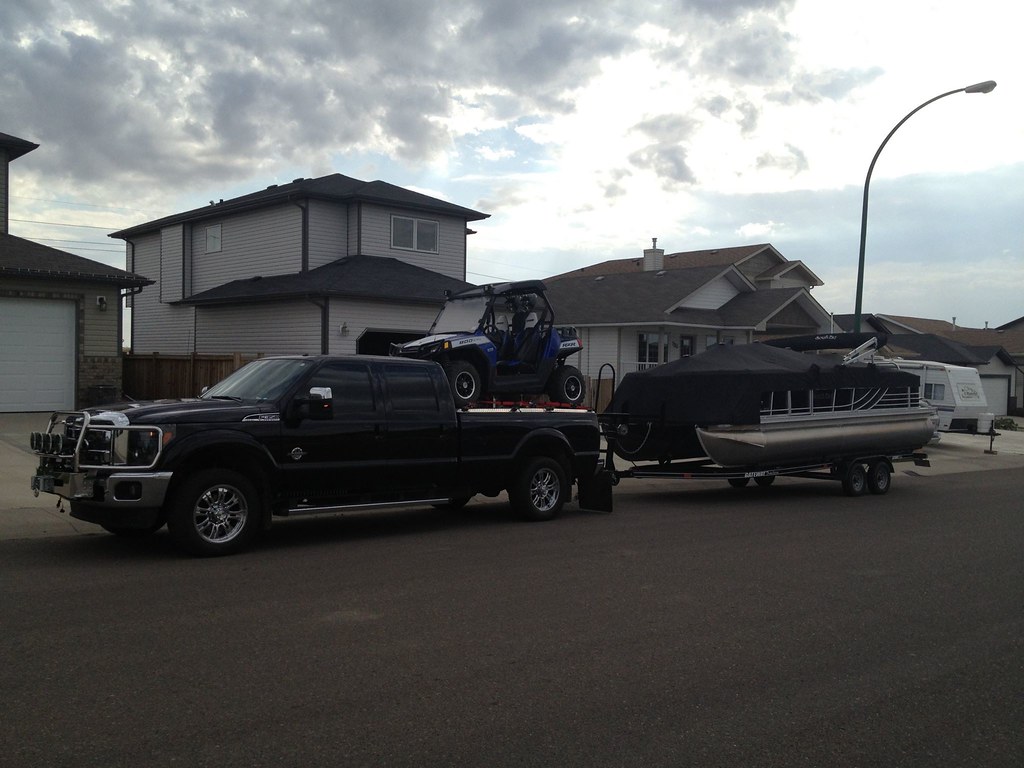
The tow vehicle's published tow capacity and Gross Vehicle Weight Rating must both exceed the loaded weight of the combination. Loaded means the boat with its engine, fuel, batteries, and all gear - not the manufacturer's dry weight. Operating at the edge of a tow rating on a 95-degree afternoon in stop-and-go traffic on US 1 is different from the controlled scenario used to generate that rating.
Tongue weight - the downward force the loaded trailer places on the hitch ball - must fall within a specific percentage range of the total loaded trailer weight. Too little causes the trailer to sway at highway speed, a condition that can escalate quickly. Too much overloads the tow vehicle's rear axle, lightens the front wheels, and reduces steering response. Your trailer manufacturer publishes the correct range for that model. Moving heavy gear forward in the boat increases tongue weight; moving it rearward decreases it.
Before every drive, check each item on this list:
- Hitch ball diameter matches the coupler; coupler latch is fully engaged and locked
- Safety chains crossed under the tongue in an X and connected to the vehicle frame, not the hitch assembly
- Brake controller connected and calibrated if brakes are required on your trailer
- All trailer lights functioning - running lights, brake lights, and turn signals
- Trailer tire pressure correct (trailer tires often require higher pressure than vehicle tires)
- Boat straps tight; motor tilted to its lock position or tied to prevent bounce
- Drain plug installed in the hull before leaving home
- Side mirrors adjusted to show the full trailer width and the traffic behind you
Driving with a Boat Trailer in Fort Lauderdale
A loaded boat trailer changes the physics of driving in ways a new driver will not fully grasp until the first hard stop. The rig is longer, heavier, and less responsive to small inputs than the vehicle alone.
Stopping distance is the most critical adjustment. A loaded trailer adds significant weight with its own momentum that does not disappear when you press the brake pedal. Double the following distance you maintain without a trailer. In Fort Lauderdale, where traffic on Federal Highway compresses quickly and drawbridge openings create sudden queue buildups, that extra distance is how you avoid panic braking in the first place.
Fort Lauderdale's canal-side streets create specific situations worth knowing before you are in them:
- Off-tracking on turns. The trailer's rear wheels cut inside the path of the tow vehicle's rear wheels. On narrow canal-adjacent streets, a turn that clears a curb easily in a solo truck will clip it with a trailer attached. Enter turns from the outside of your lane and sweep wide.
- Drawbridge approaches. Fort Lauderdale has numerous drawbridges that open on schedule or on request. Watch bridge-tender signals early and begin reducing speed well before the gate drops - the extra momentum of a trailer makes last-second stops difficult.
- Lane changes. The trailer's length means you need a longer gap than you would in a car. Signal earlier, wait for a gap that accommodates the full rig, and confirm the trailer has cleared before completing the merge.
How to Back a Boat Trailer Down a Ramp
Backing a trailer is the skill that separates confident trailerers from everyone who holds up the ramp queue. The physics are counterintuitive until one concept clicks: place your hand at the bottom of the steering wheel. Move that hand left and the trailer goes left. Move it right and the trailer goes right. This is the exact opposite of what happens driving forward, and every new driver overcorrects at least once because of it. Practice this in an empty parking lot before you attempt a real ramp with other drivers in line behind you.
At the ramp, follow this sequence in order:
- Pull into the staging area - not the ramp lane - and complete all preparation there: install the drain plug, remove tie-down straps, attach dock lines, lower the motor to its launch position.
- Pull onto the ramp and line up with the center of your lane, then pause.
- Observe the ramp angle and water depth so you know how far to back in before the boat floats free.
- Select reverse and back slowly using short, deliberate steering corrections - large inputs cause jackknifing.
- Stop when the bunks are submerged enough for the boat to float free of the trailer.
- Set the parking brake before stepping out of the vehicle.
- Once the boat is moved to a dock, pull the trailer forward off the ramp immediately to clear the lane.
- Park the rig in the designated trailer lot, then return to the dock to board the boat.
Jackknifing happens when the angle between tow vehicle and trailer becomes too acute. If the trailer starts to angle sharply, pull forward to straighten before resuming. Trying to back out of a jackknife almost always makes the angle worse, not better.
The biggest efficiency gain at any public ramp is preparation done before you pull onto the ramp. Every driver in the queue behind you is waiting for your launch - not your rigging.
Fort Lauderdale's Main Public Boat Ramps: Cooley's Landing and Cox's Landing
Fort Lauderdale operates two primary public ramps accessible to any licensed driver with a registered trailer and vessel. They serve different parts of the city and differ enough in configuration that knowing both helps you choose the right one.
| Ramp | Launching lanes | Trailer parking | Hours | Permit options |
|---|---|---|---|---|
| Cooley's Landing | 2 lanes | 67 spaces | 24 hours | Hourly only |
| Cox's Landing (SE 15th St) | 4 lanes | 63 spaces | 24 hours, enforced | Hourly, monthly, or annual |
| Hollywood Marina Ramp | 4 lanes | Approximately 38 spaces | Check Hollywood Parks | Check Hollywood Parks |
Cooley's Landing provides access to the New River system on the western side of the city. Its two lanes move traffic efficiently on moderate-use days but can back up on busy weekend mornings. Its trailer parking capacity - larger than Cox's Landing - makes it the better choice when you plan to leave the rig for a full day on the water. Current location, fees, and hours are at fortlauderdale.gov/parks.
Cox's Landing near SE 15th Street accesses the Intracoastal Waterway and Port Everglades with four launching lanes. Double the lanes means noticeably shorter queues when the ramp is busy. The per-hour parking rate runs higher, but monthly and annual permits make it economical for frequent users. Both ramps enforce their fees around the clock - not just during peak hours.
During FLIBS in late October, both ramps see elevated traffic as show participants and delivery crews move vessels in and out of Port Everglades. Arrive early, complete all rigging in the staging area, and expect longer queues than any other period of the year. Showing up to a FLIBS-week ramp unprepared is the fastest way to become the driver everyone behind you is waiting on.
Frequently Asked Questions
Does a Florida learner's permit allow towing a boat trailer?
A learner's permit does not prohibit towing, but all permit restrictions remain in effect. A licensed adult must be in the front passenger seat for any drive, including one with a trailer attached. Nighttime restrictions and passenger limits apply the same way they do without a trailer.
How do I know if my trailer legally requires brakes?
Florida law sets a gross weight threshold above which brakes are required on every trailer axle. Gross weight is the loaded figure - boat, engine, fuel, gear, and trailer frame combined - not the empty trailer weight. Look up the current threshold at flhsmv.gov, then weigh or estimate your loaded combination to determine whether brakes are legally required on your rig.
My pontoon boat is quite wide - do I need a permit to tow it on Fort Lauderdale streets?
It depends on the beam. Florida law sets a width threshold above which the combination is classified as over-dimensional and requires a permit from the Florida Department of Transportation before any road movement. Measure the widest point of your boat and check the current threshold at fdot.gov. If you exceed it, the permit specifies approved routes and may restrict travel hours.
Is there a practical difference between Cooley's Landing and Cox's Landing for an everyday boater?
Yes. Cox's Landing has four launching lanes versus Cooley's Landing's two, which matters on busy mornings and especially during FLIBS week - four lanes mean significantly shorter waits. Cooley's Landing has more trailer parking spaces, which matters for all-day trips. Location also differs: Cooley's Landing connects to the New River on the western side; Cox's Landing opens to the Intracoastal and Port Everglades. The hourly parking rate and permit options differ as well - check fortlauderdale.gov/parks for current figures on both.
What is the best way to practice backing a trailer before going to a real ramp?
Use a large empty parking lot, typically found at schools or shopping centers on Sunday mornings. Place a cone or trash can as a target and practice backing toward it from different angles and starting positions until the steering reversal becomes instinctive. One or two hours of lot practice eliminates most of the overcorrection that causes jackknifing and ramp delays. Do not attempt a public ramp for the first time under the pressure of a queue behind you.