A tire blowout at highway speed sounds like a gunshot. The car lurches hard to one side, the wheel shudders in your hands, and every instinct in your body screams to slam the brakes. That instinct will get you killed. The Florida Driver License Handbook is specific about what to do instead - and for new drivers and teens navigating I-95 or I-595 in Broward County, knowing those five steps before the blowout happens is the difference between a roadside inconvenience and a multi-car wreck.
What a Blowout Actually Feels Like - and Why Your First Instinct Is Wrong
Most new drivers imagine a blowout as a gentle hiss, a tire slowly going flat. Highway blowouts are nothing like that. When a tire fails at 65 mph, the rubber disintegrates in a fraction of a second. The sound hits first - a loud bang or boom, sometimes close enough that passengers duck thinking something struck the windshield. Immediately after, the car pulls hard toward the blown tire. If it is a front tire, the steering wheel fights your hands. If it is a rear tire, the back end swings.
The vibration is violent. The rim, now exposed, catches the road surface and sends shuddering through the entire chassis. All of this happens in under two seconds. Your brain, reading "car is out of control," sends one command: stop. So you reach for the brake pedal.
This is exactly wrong. Braking hard during a blowout shifts the car's weight forward onto the already-compromised front end. If a front tire blew, hard braking forces more load onto the failed side, worsening the pull and pushing the car toward a spin. If a rear tire blew, weight transfer to the front unloads the rear axle and can cause the back end to break loose. Either way, hard braking in the first seconds of a blowout significantly raises the risk of a rollover or loss of directional control. NHTSA estimates tire failure contributes to more than 11,000 crashes in the United States every year - and the crash is not always caused by the blowout itself. It is often caused by the driver's reaction to it.
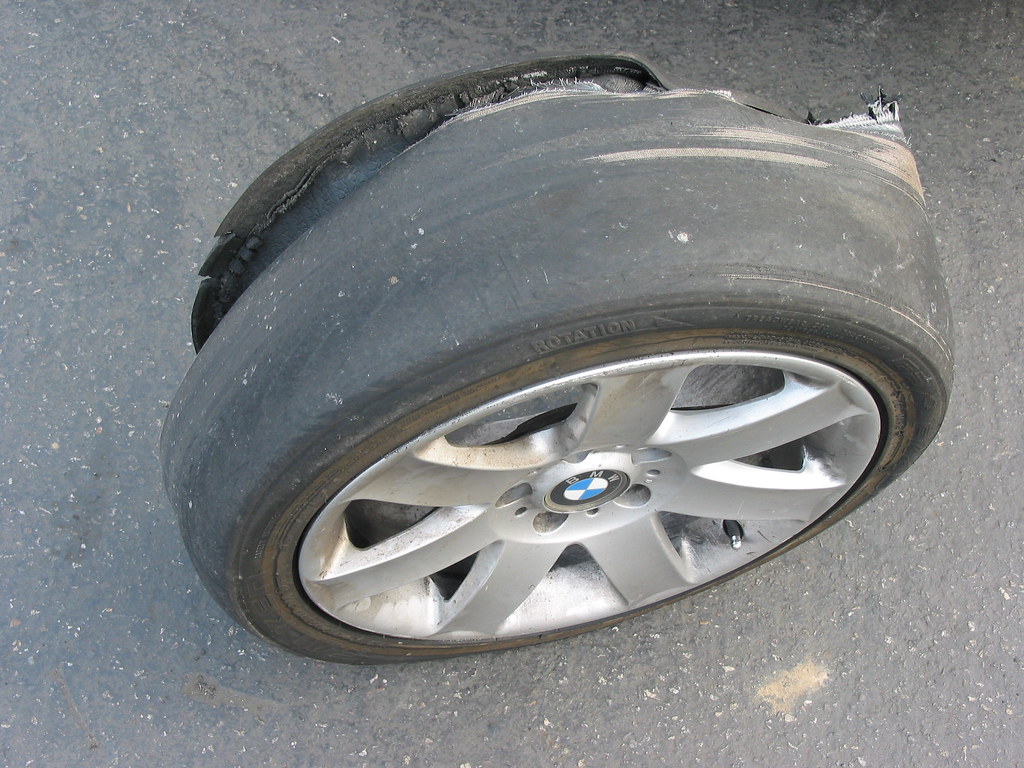
The Florida Driver Handbook's Exact 5-Step Blowout Protocol
Florida's official driver education source does not leave this to common sense. The Florida Driver License Handbook lays out a five-step sequence for handling a tire blowout. Follow them in order.
- Take your foot off the gas. Do not brake, do not steer sharply - just release the accelerator. The car begins to decelerate on its own. Removing engine input stabilizes the drivetrain and starts slowing you without weight transfer.
- Do not apply the brakes. This is the counterintuitive core of the protocol. Braking during a blowout amplifies instability. Keep your foot completely off the brake pedal for the first several seconds. Let aerodynamic drag and tire friction do the work.
- Concentrate on steering. Both hands on the wheel, firm grip, eyes forward looking where you want the car to go. Resist the pull. The car wants to go toward the blown tire - you counteract that with steady steering input. Small, deliberate corrections keep the car tracking straight.
- Slow down gradually. Once the car is stabilized and tracking straight, begin decelerating naturally. If you are on a highway, signal early and move toward the right shoulder lane by lane, checking mirrors before each lane change.
- Brake softly only once the car is under control, then pull completely off the pavement. When the car is tracking straight and speed is reduced, apply light brake pressure to come to a full stop. Do not stop in a travel lane. Get fully off the pavement.
Mastering this sequence before you are in the moment - not during the moment - is what turns a potential crash into a controlled stop.
That entire sequence demands that you override a hard-wired fear reflex. The only way to do that reliably is to have practiced it mentally, or with an instructor walking you through emergency vehicle dynamics on a real road.
Why South Florida's Heat Makes Blowouts Far More Likely
Tire blowouts are not evenly distributed across the calendar or the country. The national peak blowout season runs from mid-May through mid-October - which in Fort Lauderdale covers the entire stretch of summer school vacation, prom season, and the months when teen drivers are on the road most. The physics behind that spike come down to heat and pressure.
Asphalt road surface temperatures in Florida can exceed 150 degrees Fahrenheit on a summer afternoon when ambient air temperatures are in the low 90s. Tire rubber is an air-filled elastic polymer. For every 10 degrees Fahrenheit of temperature increase, tire pressure rises by approximately 1 PSI. A tire correctly inflated on a cool morning can read 5 to 8 PSI higher after an hour of highway driving on hot Broward asphalt. That sounds like a good thing - fuller tire, more contact. It is not. Overheated, over-pressurized tires have less flex. The sidewall and tread plies experience greater stress with every rotation.
Underinflation is the root cause of roughly 80 percent of all blowouts nationally. South Florida adds a second mechanism: heat-degraded rubber that fails from the inside, suddenly and without warning. Heat is a contributing factor in 46 percent of all tire failures. Florida's sustained summer temperatures also shorten tire lifespan considerably. Tires that would reach around 60,000 miles in a moderate-climate state may only last somewhere between 40,000 and 50,000 miles in Broward County. A tire that looks fine - acceptable tread depth, no visible bulges - can have degraded internal polymer structure if it is more than six years old and has spent those years in South Florida heat. The sidewall can fail suddenly with no visible warning at all. This is not an edge case. More than half of all vehicles on U.S. roads are estimated to have at least one under-inflated tire at any given time.
Where to Pull Over on Fort Lauderdale's Highways
Knowing the protocol is one thing. Having a mental map of where you can actually execute it in Broward County is another.
I-95 in Broward County
I-95 is the most traveled highway in Fort Lauderdale and one of the most dangerous places in the state to have a breakdown. FDOT crash data identified the I-95 corridor from Hollywood Boulevard in Broward County south through Miami-Dade County as Florida's deadliest highway segment for Move Over incidents, with more than 50 fatal crashes recorded in that stretch. One major reason is shoulder width. I-95 in Broward County has notably narrow shoulders - in some sections barely enough room for a single car to sit fully off the travel lane. FDOT has plans to expand shoulders in five specific locations to create safer breakdown zones, but those projects are not complete everywhere. A blowout on I-95 in Broward is genuinely dangerous once you are stopped, not just while it is happening.
Your goal on I-95 is to reach an exit ramp if at all possible. A damaged rim grinding on asphalt can carry the car farther than most new drivers expect. If you cannot reach an exit, pull as far right as the shoulder allows, well past the white fog line, and get the entire car off the pavement.
I-595 and the Sawgrass Expressway
I-595 generally has wider shoulders than I-95 and more predictable sight lines. The Sawgrass Expressway has designated breakdown areas at intervals. On both roads, the pull-off principle is the same: use gradual deceleration to aim for an exit or a wide shoulder point, never stop suddenly, and never stop on a bridge or overpass. An elevated structure gives you nowhere to go if a passing vehicle comes too close.
Surface Roads - A1A, US-1, and Oakland Park Boulevard
Most highway blowout articles skip surface roads entirely. A blowout is just as possible on A1A along the beach or on US-1 through central Fort Lauderdale, and those roads sometimes have no shoulder at all. The five-step protocol still applies, but your exit targets change. Aim for a parking lot entrance, a bus pull-off bay, a side street, or a gas station apron. If none of those are reachable and you must stop in a lane, turn on hazard lights immediately, call 911, and stay in the car with your seatbelt on until help arrives. Do not stand on a narrow surface road with moving traffic beside you.
What to Do Once You Are Stopped
Stopping is not the end of the emergency. How you manage the next few minutes determines whether a bad situation stays controlled.
- Hazard lights on the moment you start slowing - not after you stop. Approaching drivers need maximum warning time, especially on I-95 where closing speeds are high and shoulders are narrow.
- Pull as far off the pavement as possible - the white fog line is a minimum, not a destination. Get the car fully onto the shoulder or grass.
- Stay in the car if traffic is passing close. On a narrow I-95 Broward shoulder with fast traffic, you are safer inside the car with a seatbelt on than standing in the thin buffer between your door and the travel lane.
- If you do exit the car - on a wider shoulder or off an exit ramp - stand behind a guardrail or on the far side of a barrier. Never stand between your car and moving traffic.
- Set out reflective triangles or flares if you carry them, positioned behind the car in the direction of approaching traffic to extend your warning distance.
Florida's Move Over Law is most often discussed from the perspective of drivers passing a stopped vehicle. It applies to you as the stranded driver too. Once your hazard lights are on, approaching drivers are legally required to vacate the lane nearest your vehicle or, if moving over is not possible, reduce their speed by a specified amount below the posted speed limit. Check flhsmv.gov for the current required reduction. Knowing this law exists means you have given approaching traffic a legal obligation, not just a courtesy request. Your hazard lights are not a suggestion - they trigger a legal duty for every driver coming up behind you.
How to Tell If Your Tires Are a Blowout Risk Right Now
The best time to catch a potential blowout is in your driveway, not on I-95. Run these four checks regularly.
The PSI Check
Check tire pressure monthly on cold tires - meaning the car has been parked for at least three hours, not just driven around the block. In South Florida summers, check every two weeks. Use the PSI figure on the placard inside your driver-side door jamb. Do not use the number molded into the tire sidewall - that is the tire's maximum rated capacity, not the correct inflation target for your vehicle.
The Penny Tread Test
Take a penny and insert it into a tread groove with Abraham Lincoln's head pointing down into the tire. Florida law sets a minimum tread depth requirement - check the current specification at flhsmv.gov. The practical read: if you can see the top of Lincoln's head above the tread blocks, the tire is at or below the legal minimum and should be replaced before you drive on a highway.
Sidewall Inspection
Run your eye along both sidewalls and look for:
- Bulges or bubbles - a bubble in the sidewall means the internal casing has partially failed and blowout risk is high; do not drive on this tire
- Cracking or surface checking - fine cracks along the sidewall accelerate in South Florida heat and signal polymer degradation even when tread looks normal
- Cuts or scrapes from curb contact - shallow ones may be cosmetic, but deep cuts that expose the cords underneath require immediate replacement
- Embedded objects - a nail or screw sitting in the tread may be holding air temporarily, but every highway mile increases the chance of sudden failure
The Age Rule for South Florida
Any tire more than six years old should be evaluated by a tire professional regardless of tread depth. Polymer degradation runs faster in Broward County's sustained heat than in cooler climates. A tire that looks visually acceptable may have internal structural damage that only shows up as a sudden sidewall failure at speed. Find the manufacture date in the four-digit DOT code molded into the sidewall - the first two digits are the week, the last two are the year of manufacture.
What to Do After a Blowout
Once you are safely stopped, you have two options: call roadside assistance or change the tire yourself. On I-95 in Broward County with narrow shoulders and fast-moving traffic, the case for staying in the car and calling roadside assistance is strong. A professional arrives with the right tools and experience to work safely in that environment. A new driver crouched behind a car on a narrow I-95 shoulder at dusk does not have those advantages.
If you change the tire yourself on a surface road with a wide pull-off and minimal traffic risk, the donut spare in most vehicles carries an important restriction: it is not designed for extended highway use. Manufacturers typically rate temporary spares at a maximum speed well below normal highway speeds - check your owner's manual for the specific limit. Donut spares are also not intended for more than the distance needed to reach a tire shop. Do not continue a long drive on a donut spare, and do not drive it at freeway speeds.
Once you reach a tire shop, the blown tire must be replaced entirely. A tire that has suffered a full blowout has structural damage to its casing that a patch does not address. If the rim ground on the asphalt for any distance, have that inspected too before putting the new tire on it.
How a Driving Lesson Prepares You for a Blowout
Reading the Florida Driver Handbook's five steps and executing them at highway speed are separated by a large gap. A behind-the-wheel driving lesson bridges part of it in ways that self-study cannot.
A qualified instructor teaches controlled braking - gradual, deliberate pressure rather than panic stomping. That same trained response is what lets you keep your foot off the brake during the first critical seconds of a blowout. Instructors also teach you to look toward where you want to go rather than fixating on the hazard, which is the exact skill you need to steer through a pull. And an instructor familiar with Broward County roads can walk you through the specific geography before you ever face it alone: where I-95 shoulders narrow, how far apart exits are spaced on I-595, which stretches of A1A leave you with no pull-off options for a quarter mile.
You cannot practice an actual blowout in a lesson car. What you can build is the individual skill set that makes the protocol executable: steady hands under stress, smooth weight transfer, mirror discipline before lane changes, and the mental habit of always scanning ahead for an exit. Those components are the difference between a driver who recovers from a blowout and one who makes it worse.
Frequently Asked Questions
Can I drive on a blown tire to reach an exit rather than stopping on the highway?
On I-95 in Broward County, where shoulders are unusually narrow and that corridor has recorded more than 50 fatal Move Over incidents, driving slowly on a flat to reach a safer exit is often better than stopping immediately on an exposed narrow shoulder. Use hazard lights, keep speed very low, and move as far right as possible. The rim will sustain damage, but that is replaceable. If you are already near a wide shoulder or off-ramp, stop there instead.