Most U.S. cities give new drivers one kind of highway to master: a free interstate with a posted speed limit and straightforward on-ramps. Fort Lauderdale gives you four expressways, each operating on different rules, and a local street grid interrupted by more than 300 miles of canals and a collection of drawbridges. Learning to drive here without understanding how these roads specifically work means encountering the rules for the first time while moving at highway speed - which is the worst possible classroom. This guide covers every major Broward County expressway in sequence, explains the toll and access rules that catch new drivers off guard, and lays out a practice progression that builds confidence without skipping steps.
Why Fort Lauderdale's Highway System Is Unlike Most U.S. Cities
Four factors distinguish Broward County expressways from the roads new drivers encounter almost anywhere else in the country. Understanding them before your first on-ramp attempt changes everything about how you plan a trip and react to what you see.
First, reversible express lanes. I-595's center toll lanes reverse direction once each weekday - running eastbound during the morning hours and switching to westbound for the afternoon and evening. No other road in the metro area works this way. Entering from the wrong direction means driving against traffic, and the physical barriers - not signs, physical arms - are what separate that mistake from a head-on collision.
Second, SunPass-only access on I-95 Express. Most Florida toll roads let you drive through without a transponder and bill your plate by mail. The I-95 Express Lanes in Broward do not offer that option. Passing through without an active SunPass generates the toll charge plus a separate fine. Many new drivers assume the mail-billing fallback exists here because it exists everywhere else.
Third, all-electronic tolling on the Sawgrass. SR-869 has no toll booths, no cash lanes, and no attendants. There is nowhere to slow down and pay. Drivers who expect a booth that no longer exists create a rear-end hazard by braking under a gantry.
Fourth, the canal-interrupted grid. Fort Lauderdale's street layout dead-ends regularly into waterways. A wrong turn near the Intracoastal can mean a quarter-mile of backtracking before you find a bridge. GPS routing doesn't always catch this.
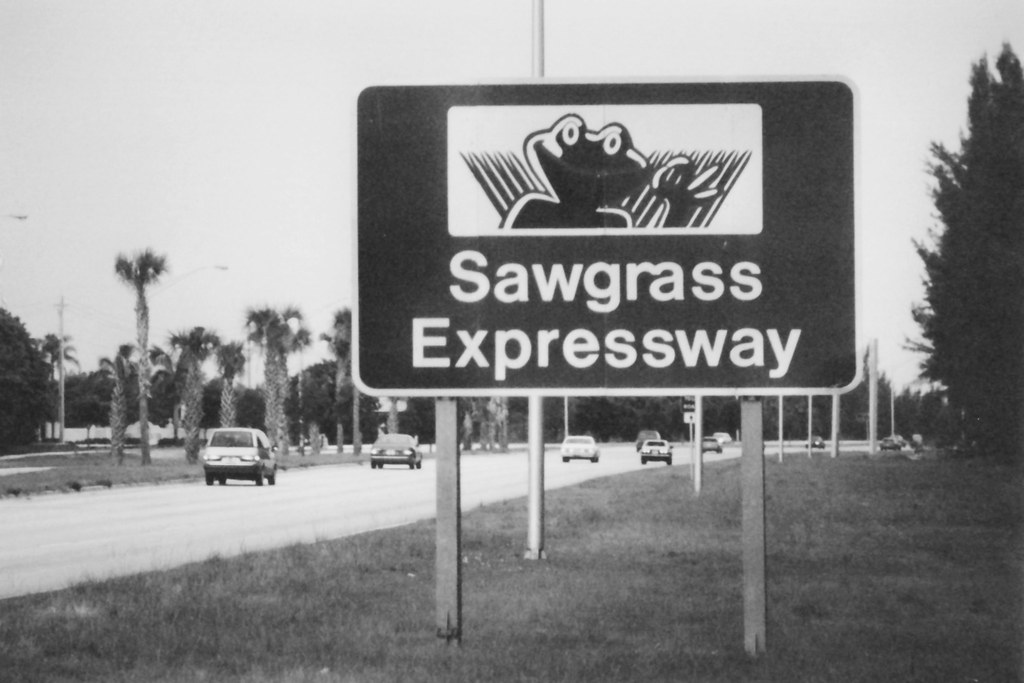
I-95 in Broward County: Speed, Merge Zones, and the Express Lane Rules Every New Driver Must Know
General Lanes and Merging
I-95 general lanes through Broward carry a posted speed limit, and traffic routinely matches or exceeds it during off-peak hours. New drivers who hesitate at the bottom of an on-ramp will find fast-moving traffic bearing down on them with nowhere to go. The merge requires matching highway speed before the ramp ends - not approaching it slowly and hoping for a gap.
The skill instructors work on first is reading the traffic stream from the ramp. You pick your gap early, accelerate to match the flow, and commit. Practicing this on a quieter road first is not optional in Fort Lauderdale. I-95 is not the place to learn it from scratch.
Express Lane Rules
The I-95 Express Lanes require an active SunPass transponder. There is no Toll-by-Plate fallback. Driving through without one triggers the toll charge plus a per-period fine - check sunpass.com for the current fine amount, as it can add up quickly across multiple violations in a single day.
Pricing is variable: the current toll appears on large overhead signs just before each entry point. You have a few seconds to read the display and decide whether to pay for the Express Lane or stay in the free general lanes alongside it. For new drivers, the right default is simple - skip the Express Lanes until highway merging is already comfortable. The general lanes are free and get you where you're going.
I-595: How the Reversible Center Lanes Work and Why You Should Always Check the Crossing Arms
The Direction Schedule
I-595 runs east-west through central Broward, connecting I-75 near Davie to I-95 near Fort Lauderdale-Hollywood International Airport. Its three center express lanes run eastbound on weekday mornings and switch to westbound on weekday evenings. On weekends, the center lanes typically run eastbound only rather than reversing - check 595express.info or FDOT's 511 line before relying on center lane access for any weekend trip.
The directional switch is enforced by railroad-style crossing arms that lower physically across entry ramps when that direction is closed. These are not advisory. They are barriers. If you arrive at an I-595 express ramp and the arm is down, the lane is closed in your direction. Do not guess, do not squeeze past, and do not assume the arm is malfunctioning. Check the overhead signage, confirm the active direction, and use the general lanes if you're uncertain.
Vehicle Restrictions
The I-595 Express center lanes restrict access to vehicles with no more than two axles. Vehicles with three or more axles must use the general lanes regardless of whether they carry a transponder, and towing a trailer also disqualifies a vehicle from the center lanes. If you are driving any non-standard vehicle, confirm the current rules at 595express.info before entering. Variable toll pricing applies the same way as I-95 - overhead signs show the current rate at each entry, and you decide in real time.
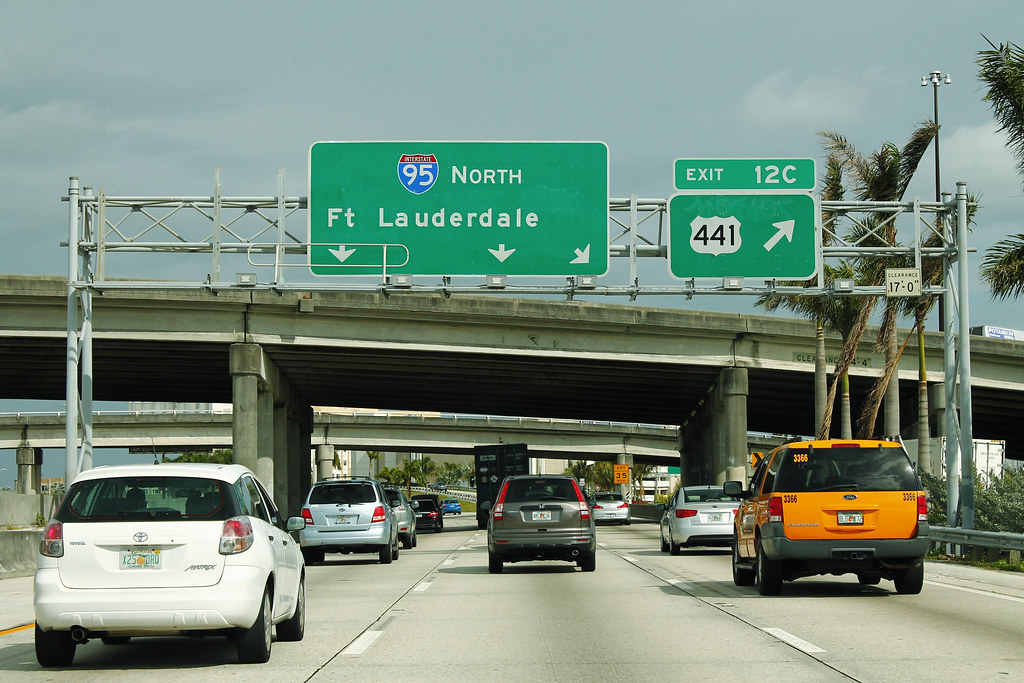
The Sawgrass Expressway (SR-869): The Best First Highway for New Drivers in Fort Lauderdale
What the Road Is and Where It Goes
The Sawgrass Expressway loops through western Broward County for about 20 miles, running from the I-75 and I-595 interchange near Davie north through Sunrise and Coral Springs, then east to Florida's Turnpike at Coconut Creek. It passes through suburban commercial corridors rather than dense urban traffic. Interchanges are spaced far enough apart that a new driver has time to settle into a lane before the next exit decision arrives.
All-Electronic Tolling in Practice
The Sawgrass accepts SunPass and several compatible transponders - E-Pass, Peach Pass, and LeeWay among them. For the current full list of accepted transponders and payment options, check floridasturnpike.com. Without a transponder, cameras photograph your plate and a bill arrives by mail at a higher rate than transponder holders pay. The important thing to understand operationally: the overhead gantries are not toll booths. There is no reason to slow down approaching one. Maintain highway speed, let the transponder handle the transaction, and keep your eyes on traffic.
How to Use It as a Practice Route
- Enter from a lower-traffic interchange - Sunrise Boulevard or Commercial Boulevard on a weekday mid-morning works well.
- Spend the first few miles focused only on lane-keeping at sustained highway speed before attempting any lane changes.
- Use an exit to loop back and repeat the entry sequence two or three times before moving on.
- Once you can enter cleanly, maintain speed, change lanes deliberately, and exit without rushing, you're ready to move to I-595's general lanes.
Florida's Turnpike and Other Broward Toll Roads: What Connects to What
Florida's Turnpike runs through central Broward County, meeting the Sawgrass Expressway at Coconut Creek in the north and continuing south toward Miami. For Fort Lauderdale drivers, the Turnpike is most relevant for trips to Miami or Palm Beach - it runs west of I-95 and tends to carry lighter traffic between the urban core and southern Broward. The Turnpike uses all-electronic tolling at most Broward points, and the same SunPass account that covers I-95, I-595, and the Sawgrass also works here. There is no need for a separate transponder or account.
When deciding between I-95 and the Turnpike for a north-south trip, the factors are destination and time. I-95 is direct through the urban core and free. The Turnpike is better for western suburbs like Weston and Pembroke Pines, where I-95 adds cross-county backtracking.
SunPass Setup Before Your First Expressway Drive
Why Before, Not After
Get the transponder before your first expressway trip. Activation takes time - check sunpass.com for the current processing window before you order, because driving with an unactivated transponder on a SunPass-only road still generates violations. Order early enough that the device arrives, activates, and carries a funded balance before you pull onto an Express Lane ramp.
Setup Steps
- Order at sunpass.com or pick up a transponder at a retail location - Publix and CVS stores throughout Broward carry them.
- Create an online account, register the transponder number, and load a starting balance.
- Mount the transponder on your windshield exactly as the instructions describe - position affects read reliability at highway speed.
- Wait for activation confirmation before using any SunPass-only road.
- Enable auto-replenishment so your balance doesn't expire mid-trip.
SunPass holders pay significantly less than Toll-by-Plate customers on Florida roads that support both methods. Over a year of regular driving in Broward County, that difference adds up. If you're driving a car registered to someone else, confirm whether a transponder is already active on that vehicle to avoid account conflicts.
Fort Lauderdale's Local Road Quirks: The Grid, Canal Dead-Ends, Drawbridges, and Las Olas
Reading the Grid Correctly
Fort Lauderdale's address system anchors at two baselines - Andrews Avenue (north-south) and Broward Boulevard (east-west). Every address carries a quadrant prefix: NE, NW, SE, or SW. Ignoring the prefix and navigating to "3rd Avenue" without knowing the quadrant puts you on a parallel street that may be a mile away from your destination. Read the full address before you start moving, not after you're already confused at an intersection.
Canal Dead-Ends and Drawbridge Waits
The city's more than 300 miles of navigable waterways mean streets near the Intracoastal Waterway dead-end without warning. GPS doesn't always flag these - it may route you down a dead-end street with full confidence. Near the beach, treat unfamiliar side streets with some skepticism until you've driven them before.
Drawbridges along the Intracoastal open on published schedules to let boat traffic pass. When one opens, traffic stops completely - not slows, stops - and the wait can run several minutes. Drivers along A1A, Las Olas at the Intracoastal, and SE 17th Street should build potential bridge delays into any time-sensitive trip during boating hours.
Las Olas Boulevard
Las Olas runs from the Central Business District east to A1A at the beach. Through the restaurant and retail corridor, the lane environment includes active valet drop-off zones, loading areas, and pedestrians crossing mid-block. A car door can open into the lane with no warning. Treat Las Olas as a slow, alert-driving zone regardless of whether traffic is light - the hazards are lateral, not just the vehicle ahead of you.
When to Drive and When to Avoid: Rush Hours, Tourist Season, and School Zones
Peak congestion on Broward expressways runs from roughly 7 to 9 a.m. and again from 4 to 6 p.m. on weekdays. New drivers practicing highway merging should avoid both windows. The lower speeds of rush-hour traffic create a different and harder challenge than open-road entry - learn the open-road version first.
December through February adds a distinct second surge. Snowbirds arriving from northern states push consistent volume onto roads that already approach capacity during rush hour. Mid-morning in January carries more traffic than mid-morning in July. New drivers scheduling practice during winter should expect conditions closer to moderate rush hour even at traditionally quiet times.
Florida school zones enforce a reduced speed limit during a window that typically begins 30 minutes before and extends 30 minutes after scheduled school sessions, though the posted signs at each zone are the legal standard - check them or current Florida statutes for the exact hours that apply. All speeding fines inside school zones are doubled. Fort Lauderdale has dozens of active school zones scattered through residential neighborhoods, and enforcement times don't always match a new driver's intuition about when school is in session.
How In-Car Driving Lessons Build Up to Fort Lauderdale's Highways Safely
The case for a progressive sequence in Fort Lauderdale is stronger than in most cities because the consequences of skipping steps are immediate. A student attempting I-95 during rush hour before practicing merging anywhere makes a high-speed mistake in dense traffic with no margin. Fort Lauderdale driving instructors use a deliberate build-up:
- Sawgrass first - lower traffic volume, no SunPass-only restrictions to navigate, well-spaced interchanges for practicing clean entries and exits.
- I-595 general lanes second - heavier volume, more complex interchange geometry near the airport, good preparation before considering the center express lanes.
- I-95 off-peak third - mid-morning on weekdays, outside rush hour, with Express Lanes off-limits until the student understands the SunPass-only rule and has read a variable-price overhead sign in practice.
- I-95 in rush hour last - the final stage, with an instructor present for the first several attempts.
Local instructors also know the specific ramps where merge lanes are shortest, which Sawgrass interchanges give the cleanest first entry, and how to read the I-595 crossing arms without breaking a student's momentum. That local knowledge is not in any manual. It comes from instructing on these specific roads regularly - which is exactly why in-car lessons in Fort Lauderdale carry value that online study or practice with a parent from out of state cannot replicate.
Frequently Asked Questions
Can I use cash on any Broward County toll road?
No - the Sawgrass Expressway, I-95 Express Lanes, and I-595 Express Lanes all use all-electronic tolling with no cash lanes. On the Sawgrass and I-595, driving without a transponder results in a Toll-by-Plate bill mailed to the registered vehicle owner. On the I-95 Express Lanes specifically, Toll-by-Plate is not an option - no transponder means the toll charge plus a separate fine.
What happens if I pull up to an I-595 express ramp and the crossing arm is down?
The arm means the center lanes are closed in that direction. Do not attempt to drive around it. Return to the general lanes and continue your trip there. If you're unsure whether the lanes are running eastbound or westbound at a given time, overhead signage at each entry point and FDOT's 511 traffic line both carry real-time status.
How far in advance should I order SunPass before my first expressway drive?
Check sunpass.com for the current activation timeline before you order - processing time varies and driving with an unactivated transponder on a SunPass-only road generates violations just as driving without one would. As a general rule, order at least a week before your first planned use, or pick up a transponder at a Broward-area Publix or CVS and complete online activation the same day.
Does the Sawgrass Expressway count as a good place to learn highway driving before I-95?
Yes - Fort Lauderdale instructors specifically use the Sawgrass as the first highway for new drivers because its traffic volumes are lower than I-95 and the interchanges give more space to settle in. The all-electronic tolling means no hesitation at booths, which actually simplifies the experience. Once a student can enter, hold speed, change lanes, and exit on the Sawgrass without coaching, I-595's general lanes are the logical next step.
Is winter really that much worse for traffic, or is rush hour the bigger concern for scheduling practice?
Both matter, and they compound each other. Rush hour sets the daily ceiling for congestion; winter tourist season raises that ceiling significantly from December through February. A mid-morning practice session that would be light traffic in summer can carry moderate congestion in January when snowbird arrivals add consistent volume throughout the day. New drivers scheduling highway practice during winter should extend their off-peak window and consider mid-week mornings over Friday mornings.