Fort Lauderdale recorded more than 27,000 traffic crashes combined across 2023 and 2024, according to Fort Lauderdale Police Department crash-location data. Most drivers involved in those crashes did not intend to cause a collision. Many of them simply misunderstood who was supposed to yield and when. Florida's right-of-way rules are not complicated, but they are specific - and the gap between knowing them in theory and applying them on Federal Highway at 5 p.m. is exactly where most errors happen.
The Core Principle: Florida Never Gives Anyone the Right of Way
The Florida Driver Handbook is precise about this: the law does not grant the right of way to any driver. It only identifies who must yield it. That distinction carries real weight beyond the road test.
If you had procedural priority at an intersection and another driver hit you, you are not automatically free of fault. Florida law also requires every driver to avoid a crash if it is reasonably possible - even when that driver holds priority. An insurance adjuster or a judge examining a crash will ask whether you saw the hazard in time, had space to stop, and took action. "I had the right of way" opens that analysis; it does not close it.
Florida traffic law specifies who must yield - it never states that any driver "has" the right of way. The obligation to avoid a crash remains even when you have priority.Florida Driver Handbook
This framing matters for Fort Lauderdale drivers specifically because the city's crash volume means you will encounter ambiguous situations regularly. Knowing the rule and knowing you still bear a residual duty to stop when you see danger are two different things - and both are tested on the road test.
Four-Way Stops and Two-Way Stops: The Exact Rules for Who Goes First
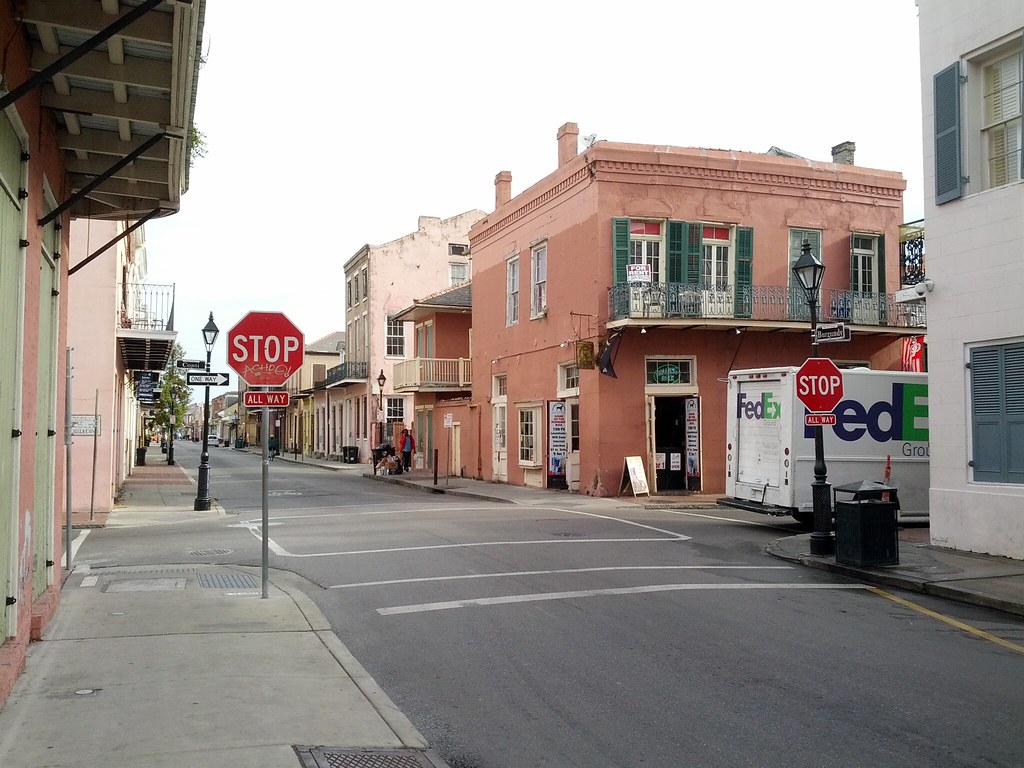
At a four-way stop, the first vehicle to come to a complete stop proceeds first. That is the primary rule, and it does not involve judgment calls or negotiation. The tie-breaker applies when two vehicles stop at the same moment: the driver on the left must yield to the driver on the right.
That tie-breaker is absolute. It is not about who is turning versus going straight, who is closer to the intersection, or who made eye contact first. If two cars stop simultaneously, the one on the left waits.
Common errors at four-way stops:
- Treating a slow roll as a legal stop - Florida requires a complete, full stop before the line
- Waving another driver through and then pulling forward at the same moment
- Assuming a vehicle going straight automatically beats one turning left - arrival order controls at a four-way stop, not direction of travel
- Applying the tie-breaker only when arrival times are identical, when in fact close-timing stops also require it
Two-way stops work differently. Only the cross-traffic controlled by stop signs must yield. The driver on the uncontrolled through road does not have to slow or stop for cross-traffic that is properly stopped. They still carry the residual duty to avoid a crash - but they hold priority and need not cede it.
Open Intersections: What to Do When There Are No Signs or Signals
Some blocks in older Fort Lauderdale neighborhoods have intersections with no stop signs and no traffic signals - what Florida law calls uncontrolled or open intersections. They look like a place where no rule applies. They are not.
The rule at an open intersection mirrors the four-way stop tie-breaker exactly: the driver approaching from the left must yield to the driver approaching from the right. Arrival time does not determine priority. Speed does not determine priority. The driver coming from the right has legal standing to proceed, and the driver to their left must yield regardless of what either expects.
When in doubt at any open intersection, treat it as a four-way stop: come to a full stop, look right, and yield if a vehicle is approaching. That habit costs a few seconds and eliminates the crash risk entirely.
Left Turns, Right Turns, and Right on Red
Left turns produce more crashes per maneuver than almost any other movement on Florida roads. The rule is unambiguous: a driver turning left must yield to all oncoming traffic. This includes a vehicle traveling through a yellow light. The yellow signal does not strip the through-driver of priority - it warns them the signal is about to change, but the turning driver must wait until the path is genuinely clear before cutting across.
The only exception is a protected green arrow. A green left-turn arrow means oncoming traffic is held at red, and the turning driver has unconditional priority to complete the turn. Absent that green arrow, the turning driver is always yielding.
Right on Red: The Steps That Must All Happen
- Bring the vehicle to a full, complete stop at the stop line or crosswalk - a slow roll does not satisfy this requirement.
- Yield to any pedestrian crossing the street you are about to turn onto.
- Check the bike lane or shoulder to your right for cyclists.
- Check for oncoming vehicles approaching from the left in all lanes.
- Proceed only when all three potential conflict points are clear and you have a safe gap.
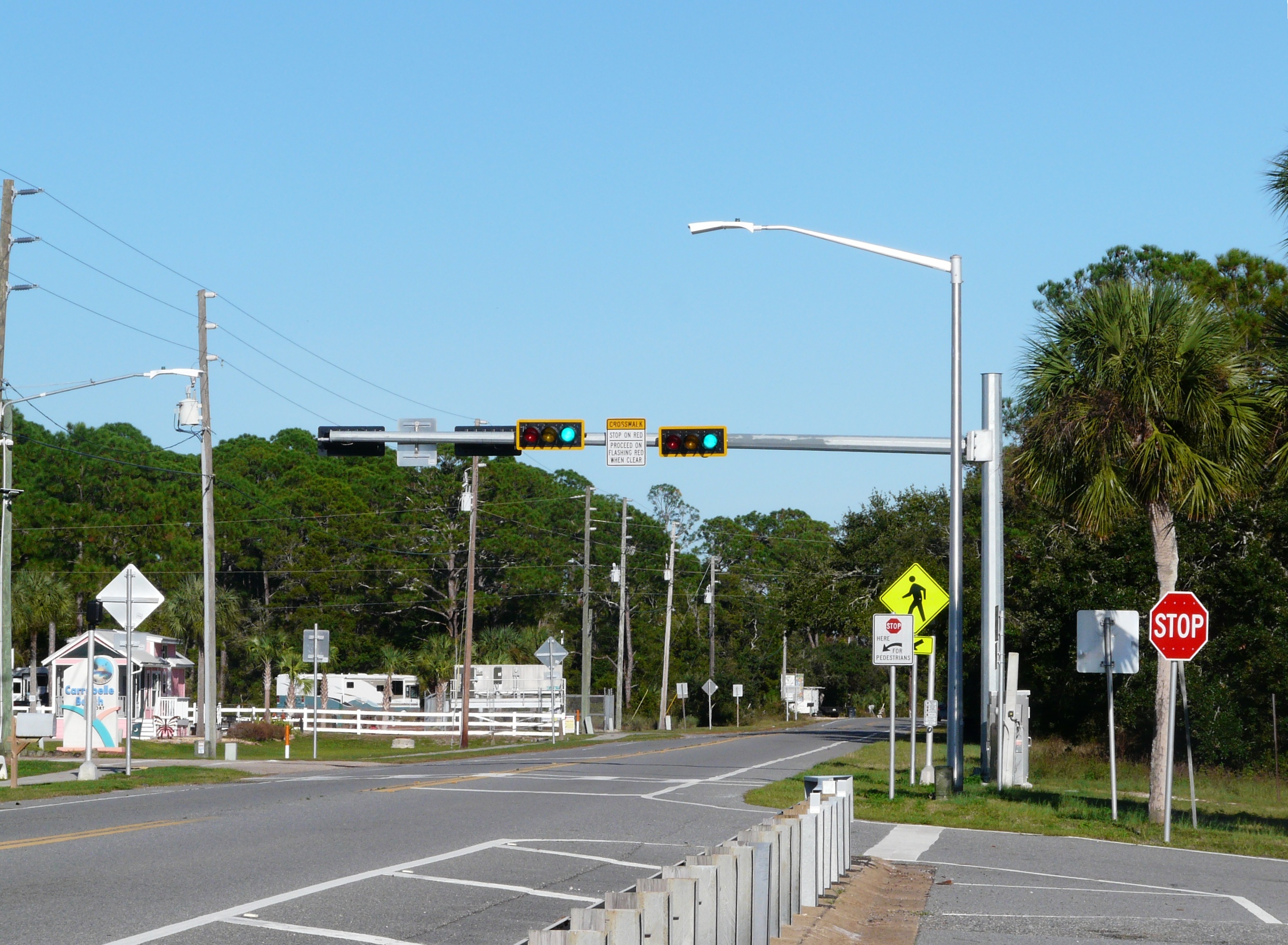
Several high-pedestrian intersections in downtown Fort Lauderdale post "No Turn on Red" signs. These are not discretionary restrictions. If the sign is posted, you cannot turn regardless of how clear traffic appears. Check for the sign every time you stop at an unfamiliar intersection before assuming the default right-on-red permission applies.
Pedestrians and Cyclists: Who Yields to Whom
Florida requires drivers to yield to pedestrians in marked crosswalks. It also requires yielding at unmarked crosswalks - and that is the provision most drivers miss. Any intersection where two roads meet has an unmarked crosswalk at each corner by default, even with no paint on the pavement. A pedestrian stepping off the curb at that corner has the legal right of way.
Mid-block is different. A person crossing between intersections where no crosswalk exists does not have the legal right of way. Drivers still must not strike them - the duty to avoid a crash is always present - but the pedestrian does not hold automatic priority in that location. Both the driver and the pedestrian share the risk of a mid-block crossing where no crosswalk is marked.
One provision requires a complete stop, not a slow-down: when a person who is blind and carrying a white cane or guided by a guide dog is anywhere near the roadway, drivers must come to a complete stop - regardless of signal phase or crosswalk markings.
Cyclists on Fort Lauderdale Roads
Florida classifies cyclists as vehicle operators. They must follow the same traffic control devices as cars, and drivers must treat them with the same deference they would give any other vehicle. When passing a cyclist on the roadway, Florida Statute 316.083 requires drivers to maintain a minimum safe clearance of at least 3 feet between the vehicle and the cyclist, and that rule applies in every lane, not only on roads with dedicated bike lanes.
The stakes in South Florida are higher than most drivers realize. Multiple years of NHTSA data show Florida has the highest bicycle fatality rate per capita in the country, consistently far above the national average. Broward County alone accounts for roughly 11 percent of Florida's annual pedestrian crash total - a 2021 FLHSMV report recorded 76 pedestrian deaths in Broward County, while statewide that same year Florida logged more than 7,000 pedestrian injuries. These are not abstract statistics; they describe the consequences of drivers underestimating cyclists and pedestrians on the same roads where Fort Lauderdale road tests are conducted.
- Yield to cyclists as you would any slow-moving vehicle in the lane - do not squeeze past in the same lane
- Check bike lanes before right turns, particularly on Las Olas Boulevard and Sunrise Boulevard where cycling traffic is consistent
- Cyclists riding in the travel lane are not violating any law - they have a legal right to be there
- A cyclist who runs a stop sign does not lose vehicle status for yielding purposes - they are still a vehicle that cross-traffic must account for

Roundabouts, Emergency Vehicles, and Funeral Processions
These three situations have rules that override the normal signal-and-sign logic most drivers rely on. Each one generates crashes and road test failures from drivers who apply everyday intersection habits where those habits do not fit.
Roundabouts
Inside a roundabout, vehicles already circulating have the right of way over every vehicle attempting to enter. Entering drivers must yield at the dashed yield line at the entry point. The solid lane markings inside the roundabout are lane dividers, not additional yield lines - by the time you are inside the circle, you are already in a travel lane and hold priority over the next vehicle approaching from an entry.
Florida DOT data show roundabouts reduce fatal crashes by up to 90 percent and injury crashes by roughly 75 percent compared to traditional intersections. That safety record exists because roundabouts eliminate right-angle, high-speed collisions. It depends entirely on entering drivers yielding properly - a driver who charges in without yielding negates the geometry that makes roundabouts safer.
Emergency Vehicles
When an emergency vehicle activates its siren or authorized emergency lights, every driver must pull to the nearest edge of the roadway and stop completely, then remain stopped until the vehicle has passed. Slowing to a low speed and drifting right is not legal compliance. The full stop is required, and the requirement applies to all drivers in the path of the approaching vehicle - not just those directly in front of it.
Funeral Processions
Once the lead vehicle of a funeral procession has lawfully entered an intersection, every vehicle in the motorcade retains the right of way through that intersection regardless of what the traffic signal does while the procession moves through. If you arrive at an intersection and a procession is moving through on red, you wait. Cutting into gaps between procession vehicles is illegal. The entire motorcade must clear before you proceed, even if your signal has cycled to green by then.
Fort Lauderdale's Most Dangerous Intersections and Why These Rules Matter Here
Right-of-way errors are not evenly distributed. Certain Fort Lauderdale corridors concentrate the risk, and understanding which ones is worth more than knowing the abstract rules alone.
The intersection of Sunrise Boulevard and Federal Highway is consistently cited in Broward County crash analyses as one of the area's most dangerous. Wide multi-lane approaches, heavy commercial vehicle mix, and multiple left-turn phases in both directions create exactly the environment where left-turn yield errors are most consequential. Drivers misjudging gap time in oncoming traffic is a recurring crash pattern at this location.
A1A at Las Olas Boulevard combines beach pedestrian traffic, restaurant foot traffic, cyclists, and vehicle through-traffic on a corridor where mid-block crossings are common even though they carry no legal pedestrian protection. The volume of right-of-way conflicts here - between vehicles and pedestrians, between cyclists and turning cars - reflects the Broward County numbers directly.
The table below summarizes the scenarios covered in this guide alongside the road test risk each one carries:
| Scenario | Who Yields | Key Condition | Road Test Risk |
|---|---|---|---|
| Four-way stop tie | Driver on the left | Both vehicles stopped simultaneously | High - tie-breaker often skipped under pressure |
| Open intersection | Driver on the left | No sign or signal present | High - many treat it as no rule applies |
| Left turn without green arrow | Turning driver | All oncoming traffic, including yellow-light phase | Very high - common automatic test failure |
| Roundabout entry | Entering driver | Any vehicle already circulating inside | Moderate - counterintuitive to new drivers |
| Right on red | Turning driver | After full stop; all three conflict points clear | Moderate - rolling stop treated as running red |
| Marked or unmarked crosswalk | Driver | Pedestrian present in or entering the crosswalk | Very high - often an immediate serious error |
Right of Way on the Florida Road Test: Errors That Get Students Failed
Failure to yield is one of the top scored errors on the Florida behind-the-wheel road test. Certain failure-to-yield situations are classified as serious errors that end the test immediately - the examiner stops the drive and the student does not pass, regardless of what went right before that moment.
The scenarios that most reliably fail students on right-of-way grounds:
- Crosswalks: Failing to yield to a pedestrian in any crosswalk - marked or unmarked - is typically a serious error. Examiners build crosswalk opportunities into the route deliberately.
- Left turns: Turning across approaching traffic without sufficient clearance, especially when oncoming traffic is in a yellow-light phase, is one of the most common immediate failures.
- Uncontrolled intersections: Entering an open intersection without yielding to the vehicle on the right draws a mark and often a serious error designation.
- Right on red without a complete stop: Examiners treat a rolling right on red identically to running a red light - the stop must be full and verifiable.
- Roundabout entry: Entering without yielding to circulating traffic often prompts examiner intervention, which ends the test.
What driving instructors observe consistently is that students who can recite the rules in a classroom stop applying them under test stress. A student who correctly explains the left-yields-to-right rule at an open intersection will pull into that same intersection out of turn during the test because their attention is on the mechanics of driving, not the intersection logic. The remedy is not more reading. It is practicing right-of-way decisions at real intersections until the response is automatic - well before the test date.
Frequently Asked Questions
If I had the right of way and someone hit me, am I automatically not at fault in Florida?
Not automatically. Florida requires every driver to avoid a crash if reasonably possible, even when they hold procedural priority. Insurance adjusters and courts will assess whether you saw the hazard, had time to respond, and took action. Having priority reduces your exposure but does not eliminate it, particularly if the other vehicle was visible before the collision.
What should I do when two cars reach a four-way stop at the same time and neither driver is certain who arrived first?
Apply the tie-breaker: the driver on the left yields to the driver on the right. That rule exists precisely for this situation. Eye contact, hand waves, and flashing headlights are not legal substitutes for the tie-breaker - and both drivers pulling out simultaneously because each assumed the other was yielding is how same-moment crashes happen.
Do pedestrians always have the right of way in Fort Lauderdale?
No. Pedestrians have the right of way in marked crosswalks and in unmarked crosswalks at intersections. A person crossing mid-block away from any crosswalk does not have the legal right of way. Drivers still must not strike them - the duty to avoid a crash never disappears - but the legal protection at a mid-block crossing is not the same as at a crosswalk.
Can I drive through a gap in a funeral procession if the traffic signal turns green in my favor?
No. Once the lead vehicle of a procession has lawfully entered the intersection, every vehicle in the motorcade retains the right of way through that intersection regardless of signal changes during the procession's passage. Wait until the entire line has cleared before proceeding, even if your signal cycled to green while the procession was moving through.
Is right on red always legal in Fort Lauderdale?
No. Florida permits right on red after a complete stop unless a "No Turn on Red" sign is posted. Downtown Fort Lauderdale has several such signs at intersections with heavy pedestrian traffic. The sign overrides the default permission entirely - always check for it before assuming you can turn, especially at intersections you have not driven before.
Which right-of-way error is most likely to end the Florida road test on the spot?
Failing to yield to a pedestrian in a crosswalk is one of the most reliably immediate failures - examiners watch specifically for it at every intersection the route includes. Cutting a left turn across approaching traffic is the other most common cause of immediate test termination. Either error can end your drive before the next maneuver begins, so crosswalks and left turns deserve the most deliberate practice before test day.