Most new drivers in Fort Lauderdale learn to avoid the right lane near slow merges. What many never learn - until they see blue lights in the mirror - is that Florida law equally restricts when you can stay in the left lane. This is not a highway-only rule limited to I-95 and I-595. It applies on US-1 through central Fort Lauderdale, on Broward Boulevard, on Oakland Park Boulevard, and on every other road where two or more lanes run in the same direction. Misunderstanding this law is one of the most common mistakes new and teen drivers make, and with active 2026 enforcement campaigns running across the state, the cost of that mistake has never been more concrete.
What Florida's Keep-Right Statute Actually Says
Florida's keep-right law requires drivers on any road with two or more lanes running in the same direction to travel in the rightmost available lane. That is the baseline. The law then carves out a short list of situations where moving left is legally permitted.
When the left lane is lawful
- You are actively overtaking and passing a slower vehicle
- You are preparing to make a left turn
- A stopped vehicle, road hazard, or obstruction in the right lane forces you left
Outside those three circumstances, the left lane is not a travel lane - it is a passing lane. Once you have passed the slower vehicle or cleared the obstruction, the law expects you to return right.
A separate provision of the same statute adds a sharper requirement. On any road with two or more lanes in the same direction, a driver may not continue operating in the furthermost left lane if they know or reasonably should know that a vehicle behind them is traveling at a higher rate of speed. That language creates the specific violation officers most commonly cite: not the moment you entered the left lane, but staying there while faster traffic stacks behind you.
A driver "may not continue to operate a motor vehicle in the furthermost left-hand lane" when they know or reasonably should know they are being overtaken from the rear by a vehicle traveling at a higher rate of speed.Florida's keep-right statute
The practical result is a two-part test. First, were you in the left lane without a lawful reason? Second, did a faster vehicle approach from behind? If both answers are yes, a citation is lawful regardless of how fast you were going.
The Overtaking Trigger: Why Going the Speed Limit Is No Defense
The single most persistent misconception among new drivers - and many experienced ones - is that traveling at the posted speed limit makes a left-lane violation impossible. It does not.
The law does not measure your speed against the posted sign. It measures your speed against the vehicle behind you. If you are traveling at the speed limit in the left lane on Broward Boulevard and a driver behind you is going faster, Florida law creates the violation the moment you stay put rather than yield. Saying "I was doing the speed limit" is not a statutory defense, and Florida courts have not treated it as one.
This catches new drivers off guard because the habit of following speed limit signs is correct in almost every other traffic context. Here, the rule shifts attention from a fixed number on a sign to a relative condition: are you moving faster than the vehicle behind you? If not, the left lane is not yours to hold.
Which Fort Lauderdale Roads Are Covered
Nearly every competing article about this law limits its examples to I-95 and I-595. That framing misses most of the roads where new Fort Lauderdale drivers will actually encounter a violation.
The statute's language is broad: any road with two or more lanes traveling in the same direction. That encompasses a large portion of Fort Lauderdale's street grid. These are among the local roads explicitly within scope.
- US-1 (Federal Highway) - runs through the heart of Fort Lauderdale with multiple lanes in each direction across much of its length
- Broward Boulevard - a major east-west connector with divided multi-lane sections through central Fort Lauderdale
- Oakland Park Boulevard - four lanes divided, connecting the coast to the western suburbs
- Sunrise Boulevard - same configuration, heavily traveled east to west across Broward County
- Sawgrass Expressway - fully covered and among the roads where enforcement is most active
- Florida Turnpike (Broward County segments) - within scope, including the interchange areas near Sunrise
- I-95 and I-595 - covered, as every competitor correctly notes, but far from the only roads that matter
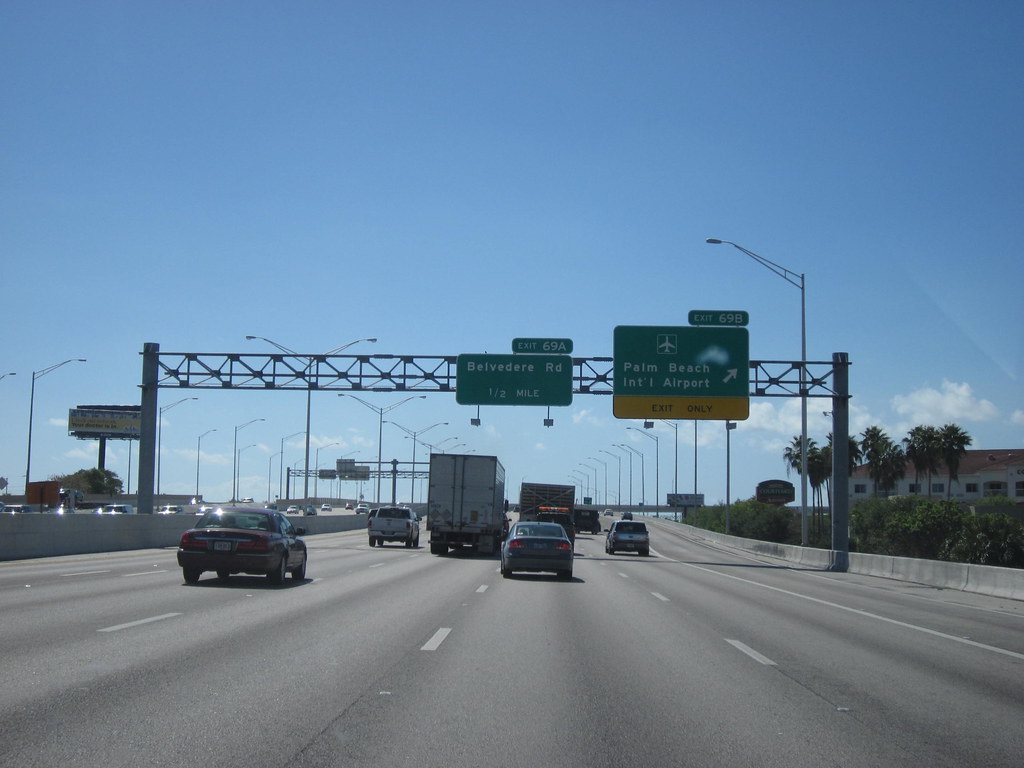
The I-95/I-595 interchange in the Fort Lauderdale and Davie area and the Turnpike split near Sunrise are identified as the highest-concentration zones for aggressive lane-change crashes in Broward County. Those are the spots where enforcement officers concentrate attention and where high speeds combined with abrupt lane changes produce the most dangerous outcomes. But the law activates every time you turn onto any divided road anywhere in Fort Lauderdale. New drivers learning the area will spend far more hours on US-1 and Broward Boulevard than on any expressway.

What a Violation Actually Costs: Fine, Points, and Insurance
A Florida left-lane violation is a noncriminal moving traffic infraction. That classification produces three separate financial and legal consequences that compound over time.
The fine
In Broward County, the base statutory fine is combined with mandatory court costs and surcharges. The total runs into the low-to-mid hundreds of dollars. Check the Broward County Clerk of Courts website for the current assessed amount, as surcharge schedules are updated periodically and the figure you see on older articles may not reflect what you would actually owe today.
License points
The violation adds three points to your Florida driver's license - the same point value assessed for a speeding ticket. Points stay on your record and factor into both the state's suspension calculation and your insurer's renewal rate.
Insurance impact
Florida insurers review point totals at renewal. A three-point moving violation is enough to trigger a rate increase with most carriers, particularly for drivers under 25. That increase compounds across the multiple years the points remain visible on the Motor Vehicle Report insurers pull. Over a three-year period, the insurance impact often exceeds the fine itself by a significant margin.
| Driver Type | Points Added | Suspension Risk | Insurance Impact |
|---|---|---|---|
| Adult, clean record | 3 | Low if no prior points | Likely rate increase at renewal |
| Adult, prior points on record | 3 | Higher - approaching thresholds faster | Larger increase; possible non-renewal |
| Teen on GDL provisional license | 3 | High - 25% of 12-point suspension threshold | Significant increase; may affect parent's policy |
| Driver electing Basic Driver Improvement course | Points withheld if course completed | Lower on first qualifying offense | Course completion may satisfy insurer requirement |
HB 317 and the DeSantis Veto: Why There Is So Much Confusion Online
In 2024, the Florida Legislature passed a bill called HB 317, titled the Interstate Safety bill. It cleared the Florida House 113 to 3 and passed the Florida Senate unanimously - an unusually strong bipartisan consensus. The bill would have created a stricter, more targeted prohibition against traveling in the left lane on roads with posted speed limits at or above 65 mph, with its own separate penalty structure.
Governor Ron DeSantis vetoed the bill before it could take effect on January 1, 2025.
That veto generated a wave of online coverage that remains a source of confusion today. Many drivers searching for current Florida left-lane law find articles written during the bill's passage or in the weeks following the veto. Some describe requirements the bill would have created but never did. Others imply that Florida effectively has no enforceable left-lane restriction because the stronger proposal was blocked.
Neither reading is accurate. The existing keep-right statute that predates HB 317 remained fully in effect throughout the legislative debate and remains in effect now. The bill would have changed specific details - particularly the threshold road type and penalty amounts. Its veto left the existing statute untouched. When you read something online suggesting Florida's left-lane law only applies on interstates or on roads at or above a certain posted speed, you are reading an artifact of the HB 317 debate, not a description of what is currently enforceable. Officers across the state are issuing citations under the statute that has been on the books for years.
The Road Rage Reality on I-95 and I-595
Florida's keep-right law is sometimes framed as a courtesy rule - a polite suggestion to help traffic flow. The data behind it is considerably less gentle.
A survey found more than 84 percent of Florida drivers admitted to misusing the left lane - a higher self-reported rate than for any other single driving behavior studied. That figure means at any given moment on a Fort Lauderdale highway, the majority of left-lane occupants may be there unlawfully. The friction that creates is measurable in specific ways.
An AAA Foundation for Traffic Safety study found nearly 80 percent of drivers reported experiencing anger or aggression specifically when a slower driver refused to yield the left lane. The same study found that 51 percent of drivers admitted to intentionally tailgating a left-lane-camping driver at least once in the prior 12 months. In a South Florida traffic environment already characterized by high volumes, dense interchange merges, and limited alternate routes, that is not an abstract statistic.
A Florida traffic safety analysis attributed 212 crashes in a single year directly to drivers failing to yield the left lane to faster-approaching traffic. Those are crashes with documented injuries and property damage - not near-misses. The I-95/I-595 interchange near Fort Lauderdale and the Turnpike split near Sunrise are the two highest-concentration crash zones in Broward County for this specific behavior pattern. New drivers learning Fort Lauderdale's highway network will encounter both interchanges within their first weeks driving independently.
The law's real function is interrupting the chain that runs: left-lane camper - frustrated driver behind - tailgating - sudden lane change - collision. Staying right does not just protect you from a citation. It removes you from the most dangerous position in that sequence.
Teen and GDL Consequences: How 3 Points Can Derail a New License
Florida operates a Graduated Driver Licensing system for new teen drivers. The GDL provisional license comes with restrictions on nighttime driving, passenger limits, and mandatory holding periods before license upgrade. It also carries point consequences that diverge sharply from what an adult driver faces.
For any Florida driver, accumulating 12 points within 12 months triggers a mandatory 30-day license suspension. Three points from a single left-lane violation puts a GDL provisional teen driver one quarter of the way to that threshold from a single ticket. A second moving violation of any kind within the same 12-month window - a rolling stop, an improper lane change, a yellow-light timing error - can push the total well into suspension territory before the driver has had any formal hearing.
There is also a practical gap that many families do not anticipate. The roads where left-lane violations are most likely to occur are not confined to I-95. US-1 and Broward Boulevard are typical supervised practice routes. Parents or supervising adults who do not know the rule may not correct the behavior during required practice hours, leaving the teen to discover it through enforcement rather than instruction. That is an expensive way to learn a rule that should be taught before the first supervised highway drive.
2026 Enforcement: What Florida Sheriffs Are Actually Doing Now
Left-lane enforcement in Florida entered a more visible phase in 2026. In August of that year, the Orange County Sheriff's Office released body-camera footage of deputies issuing citations to left-lane campers as part of a statewide enforcement awareness campaign. The footage circulated across Florida television markets, including South Florida, and the message from the Sheriff's Office was deliberate: these were not warnings.
The Florida Highway Patrol and Brevard County Sheriff's Office launched a joint initiative targeting left-lane violations alongside other aggressive driving infractions. The campaign name - "This is the Only Warning You're Getting" - reflected a shift from roadside signs asking drivers to keep right toward active citation issuance. Law enforcement leadership from other counties across the state signaled alignment with that posture following the media coverage.
For new Fort Lauderdale drivers, the practical change is this: the distance between the law existing and the law being enforced has narrowed. Officers who historically prioritized higher-severity violations now have visible public support and explicit direction to write left-lane tickets. If you are stopped, the following steps apply.
- Move to the right shoulder cleanly - do not brake suddenly in live traffic
- Have your license, registration, and insurance card ready before the officer reaches your window
- Do not argue the speed limit defense at the roadside - that conversation belongs in a hearing, not at the car window
- Request a copy of the citation and note the exact date, time, road, and direction of travel if you plan to contest it
- Contact the Broward County Clerk of Courts to ask about Basic Driver Improvement eligibility before paying the fine, since paying may waive your right to elect that option
Practical Guidance: What to Do When You Realize You Are in the Wrong Lane
The moment a new driver recognizes they have been sitting in the left lane too long - or notices faster traffic building behind them - the instinct is sometimes to freeze or tap the brakes. That reaction is more dangerous than the original positioning error. The right response is methodical.
- Check your center mirror first. Assess how close the following vehicle is and how fast it is closing. Do not make an abrupt move until you have that picture.
- Check your right-side mirror. Confirm there is a usable gap in the lane to your right - you need roughly one car length of clear space to merge without forcing anyone to brake.
- Check your right blind spot with a shoulder glance. Mirrors do not cover this zone, and vehicles there are invisible until you physically look.
- Signal your intent to move right. Even if the right lane appears clear, Florida law requires a turn signal for lane changes, and signaling creates a record of your intent if there is a dispute later.
- Merge at your current speed - do not slow down to create the gap, because that will cause the tailgater behind you to close faster. Match traffic speed in the right lane, then adjust.
- Stabilize in the right lane and hold your position. Do not re-enter the left lane until you have a lawful reason to pass.
One additional point specific to Fort Lauderdale's surface roads: on US-1 and Broward Boulevard, the left lane near intersections often doubles as a turn lane. If you are in the left lane and approaching an intersection where you do not intend to turn, begin moving right well in advance - not in the final seconds before the stop line. That zone where through traffic and turn-lane traffic overlap is where the most abrupt and dangerous last-second moves happen, and it is exactly the kind of maneuver that produces the aggressive lane-change crashes documented at South Florida's busiest corridors.
Frequently Asked Questions
Does Florida's left-lane law apply if I am already going faster than the cars in the right lane?
Yes. The law does not compare your speed to the vehicle beside you - it compares your speed to the vehicle approaching from behind. If a driver behind you is traveling faster than you, you are required to yield the left lane regardless of what the right lane is doing. Check the Florida Department of Highway Safety and Motor Vehicles website for the current statutory text.
HB 317 was vetoed - does that mean Florida has no real left-lane law right now?
No. HB 317 was an additional bill that would have added a stricter provision targeted at high-speed roads. Its veto in 2024 left the existing keep-right statute fully intact and actively enforced. Any article suggesting the veto eliminated Florida's left-lane restrictions is misreading the legislative history.
Can I be ticketed on Broward Boulevard or US-1, or only on I-95?
You can be cited on any Fort Lauderdale road with two or more lanes running in the same direction - including Broward Boulevard, US-1, Oakland Park Boulevard, Sunrise Boulevard, and the Sawgrass Expressway. The statute draws no distinction between local surface roads and limited-access highways. If the lanes run parallel in one direction, the rule applies.
My teenager has a GDL provisional license. How serious is a single left-lane ticket for them?
Three points from one left-lane citation puts a GDL provisional driver a quarter of the way toward the 12-point threshold that triggers a mandatory 30-day suspension. A suspension during the GDL provisional period can also affect progress toward an unrestricted license, potentially restarting required supervised driving time. It is among the more consequential routine traffic citations a teen driver can receive.
What is Basic Driver Improvement and can it help after this kind of ticket?
Florida's Basic Driver Improvement course allows eligible drivers to complete an approved traffic school program to withhold points from their license record after certain moving violations. Eligibility depends on how recently you last used the option and the nature of the citation. Contact the Broward County Clerk of Courts before paying the fine - paying can waive your eligibility to elect the course - and ask for the current list of approved providers and any applicable deadlines.
If a driver is tailgating me aggressively in the left lane, should I speed up to get away from them?
No. Accelerating to satisfy the tailgating driver puts you at risk of a speeding citation and does not resolve the left-lane positioning problem. The correct move is to check mirrors and your right blind spot, signal, and merge right at a steady speed when a safe gap exists. If the right lane is temporarily blocked, hold your speed and merge as soon as space opens - do not speed up, and do not brake suddenly.