A Fort Lauderdale teenager who stayed up most of the night and then drove to school the next morning may not feel drunk. But according to research cited by OSHA, their brain is operating as though they were. That gap between how impaired a drowsy driver feels and how impaired they actually are is what makes fatigue one of the most underestimated hazards on Broward County roads - and one of the most overlooked subjects in standard driver education.
Drowsy Driving Is Impaired Driving: The BAC Comparison Explained
The link between sleep deprivation and alcohol impairment is not rhetorical. OSHA-cited research establishes that staying awake for 17 consecutive hours produces driving impairment equivalent to a legally significant blood alcohol concentration - a level already associated with degraded steering response, slower hazard recognition, and reduced lane-keeping. After 24 hours without sleep, that equivalence rises to a figure above Florida's adult legal driving limit. For the current Florida BAC thresholds, check flhsmv.gov directly, because those legal figures can change and a stale number in an article creates a false floor.
The research direction, however, is not ambiguous: the longer a driver goes without sleep, the more closely their impairment mirrors a driver who has been drinking - with no alcohol involved and no way to detect it at a traffic stop.
What This Means for Drivers Under 21
Florida holds drivers under 21 to a zero-tolerance impairment standard significantly stricter than the adult threshold. A teenager who has been awake since 6 a.m. and is still driving at 11 p.m. has already logged 17 hours without sleep. The OSHA-cited research suggests their impairment already approaches a BAC level that would put them in DUI territory if alcohol were the cause. Florida law does not draw a bright line for drowsy driving - but the physiology does.
The only proven countermeasure for drowsy driving is genuine sleep. Caffeine, open windows, and loud music can suppress the feeling of fatigue briefly, but they do not restore the reaction time or judgment that sleep deprivation has already taken.

The Ronshay Dugans Act: A Florida Law Most Drivers Have Never Heard Of
In 2008, an 8-year-old girl named Ronshay Dugans was riding a school bus in Florida when a cement truck driver fell asleep at the wheel and struck it. She died. Two years later, the Florida Legislature passed the Ronshay Dugans Act, designating the first full week of September as Drowsy Driving Prevention Week statewide.
Most Florida drivers - including many who have completed formal driver education - have never heard of this law. It does not create a new criminal offense or impose new penalties. Its function is awareness: directing state agencies and safety organizations to reach the public during that week each September, with particular attention to Florida's more than 456,000 licensed teen drivers. The FLHSMV supports a dedicated drowsy driving safety center in connection with this annual observance.
The story behind the law matters beyond the legal text. Ronshay was not struck by a speeding driver or a drunk driver. She was struck by a driver who fell asleep - which, by definition, happens without warning and without the driver choosing it. That is the defining problem with fatigued driving: the moment it becomes dangerous is often the moment the driver loses the ability to recognize anything.
Florida's Legal Gap: What Charges Actually Apply After a Crash
Florida has no standalone statute making drowsy driving a criminal offense by itself. A fatigued driver who causes a crash cannot be charged under a "drowsy driving law" because no such law exists. This surprises many families after a crash and leads many teen drivers to assume fatigue carries no legal risk.
Reckless Driving and Vehicular Manslaughter
What Florida does have are broader statutes that reach a fatigued driver once harm occurs. A driver who operates a vehicle with willful or wanton disregard for the safety of others - which prosecutors can argue includes driving while severely sleep-deprived and aware of it - can be charged under Florida's reckless driving law, a misdemeanor. If that crash seriously injures or kills someone, the charge can escalate to vehicular manslaughter under Florida's manslaughter statute, a felony. For current statute language and charge classifications, check leg.state.fl.us, Florida's official statutes database.
For teen drivers, this gap cuts both ways. There is no automatic charge for drowsy driving short of a crash, so a fatigued teen who avoids one will likely face no consequences. But if a crash does happen and prosecutors establish impairment by fatigue - through witness accounts, black box data showing no braking, or the driver's own statements - the charges that result are serious felonies with lasting consequences, not traffic fines.
Teen Drivers Are the Highest-Risk Group - and the Numbers Show Why
Drowsy driving does not affect all age groups equally. Drivers ages 16 to 24 are 80 percent more likely to be involved in a drowsy driving crash than drivers ages 40 to 59, making young and new drivers the single highest-risk demographic across major research on the subject.
Several factors stack on top of each other for teen drivers specifically:
- Biology: Adolescents need more sleep than adults - typically nine or more hours - but school schedules, social lives, and extracurricular demands consistently prevent them from getting it.
- Inexperience: New drivers carry higher cognitive load behind the wheel already. When fatigue degrades processing speed and attention, there is less mental reserve to compensate.
- Impairment blindness: Teen drivers are less likely than experienced drivers to recognize that their performance has already degraded. This mirrors the alcohol impairment pattern: the most impaired person in the car is often the last to know it.
- Social timing: Late-night driving after events, parties, and beach gatherings is common in the 16-to-24 age range, placing inexperienced drivers on the road during peak fatigue hours.
A 2019 study in JAMA Pediatrics found that nearly half of teen drivers ages 15 to 18 reported driving drowsy in the past year. A 2025 National Sleep Foundation survey found 16 percent said they had gotten behind the wheel while drowsy. Research cited by Florida's FLHSMV found that teens sleeping fewer than eight hours per night are one-third more likely to crash than those getting adequate rest. Those three findings together describe a large group of drivers who are chronically under-rested, unaware of their impairment, and still getting in the car.
The Two Daily Danger Windows - and Fort Lauderdale's Role in Both
Drowsy driving crashes cluster in two predictable time windows, both driven by the body's circadian rhythm. The more widely known window runs midnight to 6 a.m., when the biological drive for sleep is at its strongest. The second window - noon to 5 p.m. - gets almost no attention in standard driver education. It corresponds to the post-lunch circadian dip that affects even well-rested adults, and hits sleep-deprived teens harder than most.
Fort Lauderdale's geography and social patterns place teen drivers directly in both windows:
- Late-night beach and Las Olas traffic: Fort Lauderdale Beach and Las Olas Boulevard stay active past midnight on weekends. A teen driving home at 1 or 2 a.m. from that corridor is in the deepest part of the midnight danger window on roads that see regular traffic and provide false confidence.
- After-school driving: A teenager who slept poorly the night before and gets behind the wheel at 3:30 or 4 p.m. is driving squarely in the afternoon circadian dip - a window that causes real crashes and almost never appears in driving courses.
- Early morning commutes: Broward County high school start times push some students out of bed before 6 a.m. after inadequate sleep, meaning they are drowsy before the school day begins.
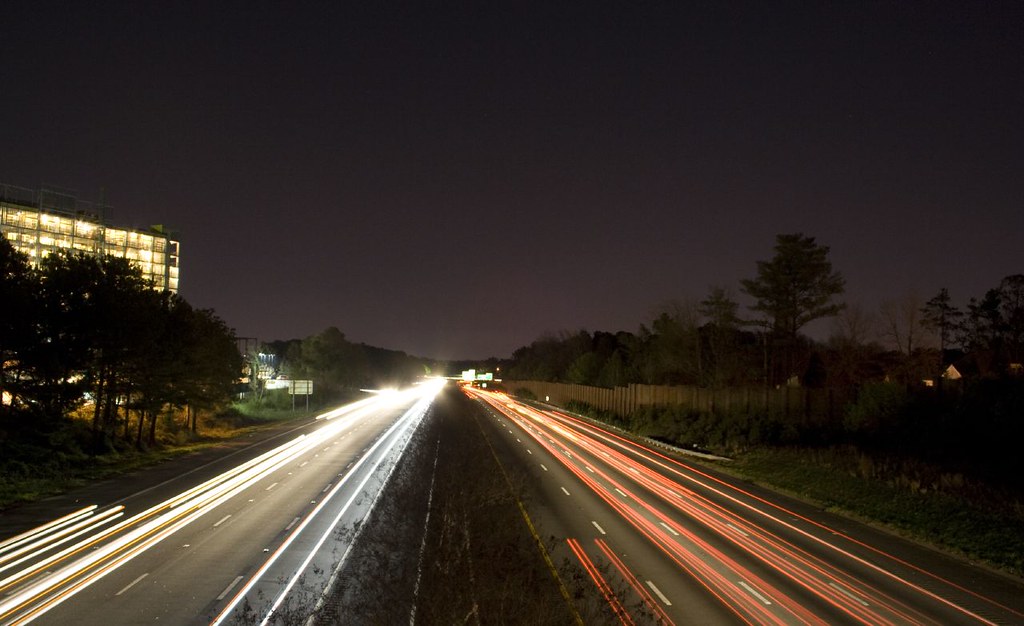
- Flat highway monotony: I-95 through Broward, I-595 heading west toward Alligator Alley, and the Florida Turnpike are long, flat, and visually uniform. These road characteristics accelerate highway hypnosis - a state in which the eyes are open and the car stays in the lane, but the brain has effectively checked out.
Broward County recorded more than 36,000 total crashes in 2025, including roughly 200 fatal ones - an average of more than 100 crashes per day. Not all are fatigue-related, but fatigue-related crashes are especially difficult to separate from the total because no roadside test for fatigue exists. The actual contribution of drowsiness to Broward's crash data is almost certainly larger than any official count reflects.
How Florida's GDL Curfew Indirectly Protects New Drivers
Florida's Graduated Driver License program restricts 16-year-old drivers to operating only between 6 a.m. and 11 p.m., with limited exceptions for employment or travel with a licensed adult 21 or older. Most teens experience this as a social restriction. What rarely gets explained is that it also functions as a fatigue-protection measure.
The midnight-to-6-a.m. window accounts for the highest proportion of drowsy driving crashes nationally. Florida's GDL curfew blocks the most inexperienced drivers - those in their first year of solo operation - from that window entirely. The overlap is not incidental. The most dangerous driving hours for a fatigued driver are the same hours new teen drivers are legally prohibited from being on the road.
That protection weakens at 17 and largely disappears at 18. New drivers who graduate past GDL restrictions are often no more sleep-experienced than they were at 16 - they simply face fewer legal limits on when they can drive. The transition away from GDL is the right moment to replace a legal constraint with a personal habit: no long solo drives after midnight, and no driving the morning after a short night without a plan to manage fatigue.
Recognizing Warning Signs Before a Crash Happens
The core difficulty with drowsy driving is that the driver experiencing it is the person least equipped to measure it accurately. Research on sleep deprivation consistently shows that impaired people overestimate their own alertness - the same cognitive distortion that occurs with alcohol.
NHTSA identifies these warning signs as indicators that micro-sleep may already be occurring:
- Frequent yawning or heavy blinking that is difficult to control
- Difficulty recalling the last few miles - the brain was not fully processing them
- Missing a turn or exit without noticing until well after it passed
- The vehicle drifting out of lane without a deliberate steering input
- Hitting or nearly hitting a rumble strip - by that point, a micro-sleep episode has already happened
Each sign indicates that the brain has already been losing consciousness in brief, uncontrolled episodes. Micro-sleep episodes last one to four seconds and are not perceived by the person experiencing them. A driver who hits a rumble strip and thinks "I just need to pay more attention" has already lost the ability to make that assessment accurately. At highway speeds, four seconds covers the length of a typical intersection.
Where to Safely Stop If You Feel Drowsy Driving in Fort Lauderdale
When any warning sign appears, the only response with genuine research support is to stop and sleep. The sequence matters:
- Signal and move toward the right lane immediately - do not wait until impairment gets worse before starting to exit.
- Take the next exit or pull into the next safe stopping location; do not try to push through to the destination because it is "only 20 more minutes."
- Park in a well-lit, visible location, lock the doors, and sleep - even 20 minutes measurably reduces acute impairment in the short term.
- If you have caffeine available, consume it just before sleeping and set a 20-to-30-minute alarm; the stimulant kicks in as the brief sleep ends, extending the window of recovered alertness modestly.
- Call someone - a parent, a friend, a rideshare driver. The cost of a pickup is measurably lower than the cost of a crash, and making that call is not a failure of will. It is a correct risk assessment.
In and around Fort Lauderdale, the quality of stopping options varies significantly by route:
| Location type | Where to find it | Available 24 hours | Safe for a brief sleep stop |
|---|---|---|---|
| Florida Turnpike service plaza | Pompano Beach plaza, northbound and southbound | Yes | Yes - designated rest facilities on site |
| I-95 designated rest area | Northbound and southbound near Broward-Palm Beach line | Yes | Yes - built for driver rest stops |
| 24-hour gas station | US-1 corridor through Fort Lauderdale and Dania Beach | Yes | Reasonable - lit, staffed, visible |
| Hospital or fire station area | Broward Health facilities, fire stations throughout county | Yes | Yes - well-lit, monitored, public |
| Highway shoulder | Any highway in Broward County | N/A | No - high risk of being struck by other vehicles |
The highway shoulder is the option to eliminate under all circumstances. Parked vehicles on highway shoulders are struck regularly - often by other fatigued or distracted drivers. Pulling onto a shoulder to rest for a moment trades one fatal risk for another.
On I-595 westbound, options thin out quickly once you pass the last Broward exits heading toward Alligator Alley. There are long stretches with no facilities and limited exits. If you are making that trip late at night, identify your planned stopping points before you leave - not after fatigue has already reduced your judgment about whether you need to stop.
Prevention: What Actually Works and What Does Not
No temporary measure removes underlying impairment. The only prevention that actually works is adequate sleep before driving and trip planning that avoids the high-risk windows where possible.
For teen drivers in Broward County, practical prevention means:
- Treating eight hours of sleep as a precondition for driving the next day - not a personal aspiration. Teens sleeping under eight hours per night are measurably more likely to crash. This is not a wellness suggestion; it is crash data.
- Scheduling long drives to Miami, Orlando, or the Keys during mid-morning, when circadian alertness is naturally highest and the afternoon dip has not yet arrived.
- Planning the ride home from late events before leaving, not after a midnight event ends. Decide at 7 p.m. how you are getting back, not at 1 a.m. when your decision-making is already compromised.
- Not getting in the car if you feel drowsy before you leave. The decision is easier, safer, and more reversible from a parking lot than from the left lane of I-95.
The AAA Foundation for Traffic Safety estimates drowsy driving causes at least 328,000 crashes and at least 6,400 deaths every year nationally - roughly one fatal crash every 81 minutes. NHTSA counted 633 deaths in police-reported drowsy driving crashes in 2023, a figure widely treated as a significant undercount because no roadside test for fatigue exists. The crashes behind those numbers happened on roads that look exactly like the roads Fort Lauderdale teen drivers use every day. Awareness of the risk is the one precondition for every prevention step that follows.