Fort Lauderdale hands every new driver a challenge that most American cities never present: navigating a drawbridge while gates descend, signals flash, and a boat works its way through a narrow waterway. No driving school textbook covers this in detail. This guide fills that gap with the signals, legal rules, local schedules, and step-by-step technique you need before your first live encounter with one of the city's many movable crossings.
Why Drawbridges Are a Driving Reality in Fort Lauderdale
Greater Fort Lauderdale has roughly 300 miles of inland waterways, with about 165 of those miles threading through the city itself. That density - canals, rivers, and the Atlantic Intracoastal Waterway cutting through neighborhoods, commercial strips, and the barrier island - is how the city earned the nickname "Venice of America." It is also why drawbridges are not an occasional curiosity. They are part of ordinary driving.
On just two waterways - the New River and the Intracoastal - drivers can encounter more than ten named, movable drawbridges. A new driver commuting from the beach to downtown, or a teenager practicing permit-stage routes with a parent, will meet one of these crossings sooner rather than later. Unlike a railroad crossing, which most drivers handle once every few months, a drawbridge in Fort Lauderdale can appear on almost any east-west or cross-waterway route.
What makes this challenging for learners is not the mechanical complexity but the combination of unfamiliar signals, legal obligations that differ from ordinary traffic stops, and the unpredictable timing of openings. A driver who has not seen a drawbridge signal before may not know whether to stop before or after the gate, what the flashing yellow light means, or whether it is legal to inch forward while the gate is lowering. The answers to those questions carry real legal weight.

Bascule vs. Swing: The Two Types of Drawbridges You'll See
Fort Lauderdale has two main types of movable bridges, and they look very different in operation. Knowing which type you are approaching helps you predict what will happen and how long the opening will take.
Bascule Bridges
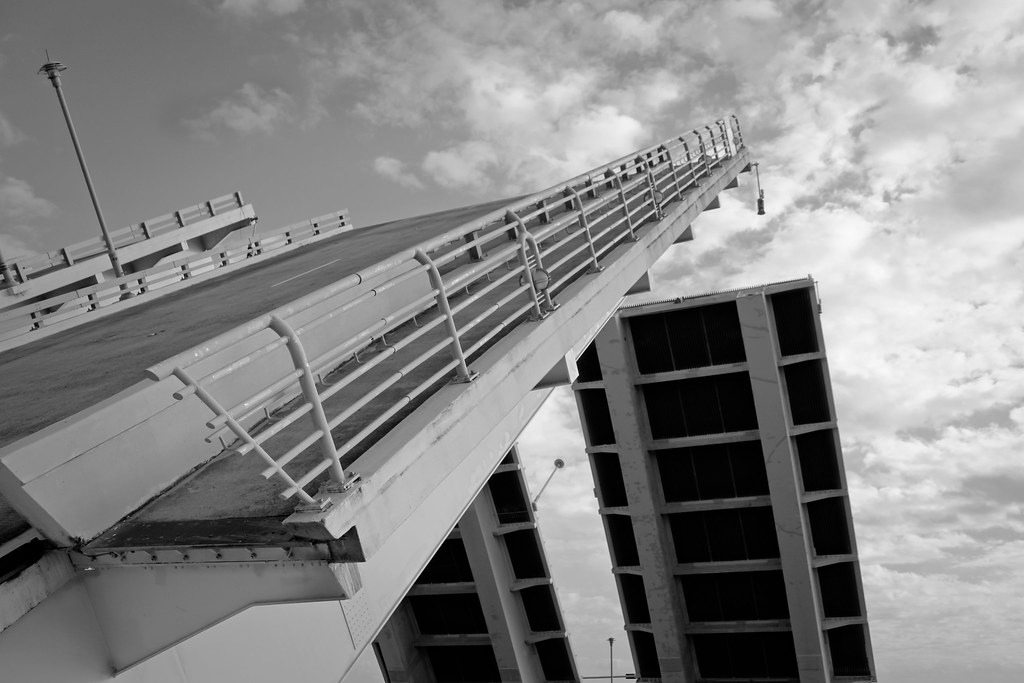
A bascule bridge has one or two leaves - flat deck sections that hinge upward from one end, pivoting on a counterweighted trunnion. Think of it as a giant trapdoor: when the tender receives a vessel request, the counterweight drops and the leaf rises skyward. The Las Olas Boulevard bridge is a bascule design; from the driver's seat you watch the road surface ahead angle upward and away. The SE 17th Street Causeway bridge works the same way. Bascule bridges are the most common type on the Intracoastal, and their motion is vertical and fairly quick.
The Florida East Coast Railroad bridge over the New River is a notable exception among bascule bridges: it is normally kept in the raised position, open to boat traffic by default, and only lowered for train crossings. A driver seeing this bridge sitting at an angle overhead should understand that the raised position is its standard state, not an emergency or malfunction.
Swing Bridges
A swing bridge does not open vertically. Its span pivots horizontally on a central pier, rotating like a clock hand until the roadway runs parallel to the waterway and boats can pass on either side. The Eleventh Avenue bridge on the North Fork of the New River is a swing-type. The motion is slower and requires more room - the rotating span sweeps a wide arc - so the signal sequence and gate-down period can feel longer than on a bascule crossing. Do not mistake slow movement for a malfunction.
Fort Lauderdale's Major Drawbridges: Where They Are
The Intracoastal Waterway runs north-south through Fort Lauderdale, and any driver crossing between the barrier island and the mainland will encounter movable bridges. From south to north, the five main ICW crossings a driver might face on a single north-south run are:
- SE 17th Street Causeway - at the Port Everglades entrance, the busiest and most schedule-regulated crossing in the city
- Las Olas Boulevard bridge - the signature crossing in the Las Olas corridor, a bascule type with frequent quarter-hour openings
- Sunrise Boulevard bridge - a mid-Intracoastal crossing used by commuters between the beach and the mainland
- Oakland Park Boulevard bridge - north of downtown, carrying Oakland Park Boulevard traffic over the ICW
- Commercial Boulevard bridge - the northernmost of the five, near the Pompano Beach border
On the New River, which runs east-west through downtown Fort Lauderdale, drivers encounter a separate cluster of movable crossings: the Andrews Avenue bridge, the SE Third Avenue bridge, the SW Second Avenue bridge, and others. The Florida East Coast Railroad bridge sits further west on the same river. Understanding this geography matters because a driver heading from Fort Lauderdale Beach to downtown could face a drawbridge wait on the Intracoastal and then another on the New River - two separate delays on a trip of just a few miles.
How to Read Drawbridge Signals: Florida Rules Every Driver Must Know
The Florida Driver Handbook defines a clear two-stage signal sequence for drawbridges. Every driver in the state is expected to know both signals before they ever approach a movable crossing:
- Flashing yellow light: Slow down and prepare to stop. The bridge is about to open. Do not accelerate to try to clear the crossing before the gate drops.
- Steady red light: Come to a full stop. The roadway is completely closed to all traffic.
Most Fort Lauderdale drawbridges pair those lights with automated crossing gates - physical barriers that lower across lanes with flashing red lights and bells, much like a railroad crossing. The critical point is that you must stop before the gate comes down, not as it reaches your bumper.
Florida law makes it explicitly illegal to drive around, under, or through a crossing gate, whether the gate is fully down, still being lowered, or just beginning to rise. This is not a gray area. It applies whether you believe the gap looks wide enough, whether you think the bridge is about to close again, or whether a navigation app is telling you to proceed. If the gate is in any position other than fully open, you wait.
A flashing yellow light at a drawbridge means slow down and prepare to stop; a steady red light means the roadway is fully closed and you must stop completely.Florida Driver Handbook
Opening Schedules: When Bridges Open and When They Don't
Not all Fort Lauderdale drawbridges open on the same schedule, and not all of them are required to open on demand at all times. Federal and state regulations set opening patterns, and several bridges carry rush-hour restrictions that can significantly affect your route planning.
| Bridge | Type | General Opening Pattern | Rush-Hour Status |
|---|---|---|---|
| SE 17th St Causeway | Bascule | Hour and half-hour during standard periods | Restricted to top-of-hour only during weekday morning and afternoon rush |
| Las Olas Blvd | Bascule | Quarter-hour and three-quarter-hour throughout the day | Unrestricted most days; special event restrictions apply (first weekend in May) |
| Andrews Ave | Movable | On vessel request outside restricted hours | Restricted - not required to open during weekday morning and afternoon rush |
| SE 3rd Ave | Movable | On vessel request outside restricted hours | Restricted - not required to open during weekday morning and afternoon rush |
| FEC Railroad bridge | Bascule (normally raised) | Stays open to boats; closes for trains only | No marine traffic schedule applies |
The SE 17th Street Causeway schedule is the most consequential one for drivers to understand - and it changed in early 2026. A rule published in the Federal Register in February 2026 modified the opening pattern during weekday rush periods. During the morning and afternoon peak commute windows on Mondays through Fridays, the bridge is now restricted to one opening per hour, at the top of the hour only. Outside those windows, it opens on both the hour and the half-hour. Federal holidays are exempt from the restriction, meaning the bridge returns to its full schedule on those days. For the exact current time windows, check the Federal Register entry or the U.S. Coast Guard Bridge Administration, since published rules supersede any static article.
Las Olas opens more frequently - on the quarter-hour and three-quarter-hour throughout the day - but carries its own seasonal restriction. On the first weekend in May, the bridge does not open during the late-afternoon hours on Saturday and Sunday due to a special event. If your route crosses Las Olas during that window on that weekend, plan for a fixed-bridge alternative. Bridge schedules can also be temporarily suspended for emergency maintenance, so checking before a time-sensitive trip is always worthwhile.
Andrews Avenue and SE Third Avenue carry weekday rush-hour restrictions during both the morning and afternoon peak periods, Monday through Friday, excluding federal holidays. During those windows, tenders are not required to open for marine traffic. As a driver, the practical effect is that these crossings become more predictable during rush hours - you can usually cross without risk of a wait. Outside restricted hours, vessels can request openings, so delays return.

Step-by-Step: What to Do When a Drawbridge Is About to Open
Following this sequence correctly protects you, gives drivers behind you time to respond, and keeps you on the right side of Florida traffic law.
- Spot the warning signals early. As you approach a drawbridge, look ahead for flashing yellow lights mounted above the roadway. Drawbridges often have approach signals positioned well before the gate itself - do not wait until you are at the barrier to evaluate the situation.
- Begin braking gradually. A flashing yellow means slow down now, not when you reach the gate. Smooth, early braking also signals to drivers behind you that a stop is coming, giving them time to react.
- Stop before the gate at the marked stop line. Pull up to the stop bar painted on the pavement. If there is no marking, stop well clear of the gate mechanism. Do not inch into the gate itself.
- Hold position and engage the parking brake on any incline. You may be waiting several minutes. There is no requirement to shut off your engine, but if you are stopped on an uphill grade, engage the parking brake rather than holding the brake pedal for the entire wait.
- Watch the bridge span, not just the gate. Observe whether it is a bascule leaf rising or a swing span rotating so you know when the operation is complete. Do not assume the gate will rise the moment the span starts to close again.
- Wait for the gate to fully rise before moving. A gate that is only partially raised is still a closed gate. Do not creep forward until the gate is completely vertical and the red light has cleared.
- Confirm that traffic ahead is actually moving before pulling forward. The first vehicle in the queue sometimes stalls or hesitates. Clear road behind the gate does not guarantee a clear path ahead.
- Accelerate smoothly back to normal speed. There will be queued traffic on both sides of the bridge. Rushing the re-start gains nothing and creates unnecessary hazard as drivers from the other direction do the same.
If you were already partway across the bridge span when warning signals activated - a rare scenario, but possible during an emergency opening - continue across and clear the span immediately. Do not stop on the bridge deck. Get completely to the far side and let the operation proceed.
Planning Routes Around Drawbridges
Good route planning in Fort Lauderdale means accounting for bridge delays before you leave, not after you are sitting in queue with an appointment in ten minutes.
- Check the schedule for your crossing before leaving. FDOT and the U.S. Coast Guard Bridge Administration publish official opening schedules. If you know you are crossing Las Olas at a specific time, you can estimate whether you are likely to catch an opening window.
- Add buffer time during marine traffic hours. Recreational boat activity peaks on weekday mornings and weekend afternoons on the Intracoastal. A bridge opening can add several minutes of delay - enough to miss a connection if you have not planned for it.
- Identify fixed-bridge alternatives on your habitual routes. Not every river crossing in Fort Lauderdale is movable. The I-95 crossing over the New River, for instance, carries enough vertical clearance that it never opens for boat traffic - a reliable choice when a drawbridge delay is unacceptable. Knowing which bridges on your regular routes are fixed lets you choose with confidence.
- Do not rely on GPS for bridge timing. Your navigation app routes efficiently for traffic but has no awareness of an impending drawbridge opening. Build that awareness yourself by learning which bridges are on your regular routes.
Managing Bridge Anxiety as a New Driver
Anxiety about driving over bridges is common enough that researchers study it. For new drivers, the discomfort is often less about the bridge structure and more about the unpredictability: you cannot know in advance whether the bridge will open, traffic behind you may feel pressuring, and the gates and signals are unfamiliar. All of that is a normal response to a new situation.
The approach that research supports is gradual exposure - building comfort in stages rather than starting at the hardest crossing first. Start by crossing fixed bridges, the kind that never move, to get comfortable with narrow lanes, water visible on both sides, and the approach geometry. Once those feel routine, cross a drawbridge when it is closed with no opening expected, so you experience the approach without the signal sequence. Only then work toward a live opening. Each stage that goes smoothly updates your nervous system's threat assessment of the next one.
Some drivers feel specific discomfort during the wait itself - sitting stopped at a gate while the span rises overhead or rotates beside them. If that describes you, try making the wait deliberate: observe the mechanical operation, notice how orderly other drivers' behavior is, watch the boat pass. The more times you go through an opening and nothing goes wrong, the more your system files it under routine rather than threat. Our driving school works regularly with nervous-driver students, and drawbridge crossings can be built into lesson routes so that students encounter them for the first time with an instructor present - not alone on the way to work.
How to Practice Drawbridge Crossings With a Fort Lauderdale Instructor
Florida's graduated driver licensing program requires a qualifying supervising adult in the front passenger seat whenever a permit holder is behind the wheel. Teen permit holders cannot go out alone to practice drawbridge crossings - and given the unfamiliar signals, gate timing, and the legal obligations involved, self-practice in this specific scenario is not a good idea regardless of the rules. For the current minimum age requirement for supervising adults under Florida's GDL program, check the Florida DMV's GDL page directly, as state requirements can be updated.
When you book lessons with a local Fort Lauderdale driving instructor, ask specifically to include drawbridge crossings. An experienced instructor can:
- Time the route to arrive at a bridge during a scheduled opening window so the student goes through the full signal sequence rather than just crossing a stationary bridge
- Name each signal in real time, before the student has to respond to it, so the response is connected to understanding rather than just reflex
- Debrief immediately after crossing while the experience is fresh - addressing any hesitation at the stop line, braking distance, or pull-forward timing
- Repeat the crossing within the same lesson if traffic and schedule allow, because two supervised experiences are worth considerably more than one
Fort Lauderdale's geography makes this practical in a way most cities cannot replicate. An instructor can plan a route that crosses the Intracoastal at Las Olas, runs north or south along A1A, and returns via a second bridge - all within a standard lesson hour. Students who have completed several supervised drawbridge crossings before their road test handle that situation with markedly more control than those who encounter a live opening for the first time during the test itself.
Frequently Asked Questions
Is it legal to cross a drawbridge while the gate is still going up?
No. Florida law requires you to wait until the gate is fully raised and clear before proceeding. A gate that is only partially up is still a closed gate, and driving under or around it in any position other than fully open is illegal. Wait until the mechanism is completely clear and the red light has cleared before pulling forward.
How long does a drawbridge opening actually take?
Most openings take somewhere between several minutes and a quarter-hour from gate descent to gate rising again, though larger vessels, slow-moving marine traffic, or a swing bridge rotating on a center pier can extend the wait. If you have a firm appointment, treat any drawbridge crossing during active marine hours as a potential delay and leave accordingly.
Do all Fort Lauderdale drawbridges open at the same times?
No - each bridge operates under its own federal or state schedule, and several carry rush-hour restrictions that prevent openings during weekday peak commute periods. Las Olas opens more frequently during standard hours than SE 17th Street does. Andrews Avenue and SE 3rd Avenue are restricted from opening on vessel request during weekday morning and afternoon rush periods, excluding federal holidays. The U.S. Coast Guard Bridge Administration publishes current official schedules.
What should I do if a bridge appears to be opening while I am already on the span?
Modern drawbridges have vehicle detection systems, and tenders normally confirm the bridge is clear before initiating an opening - so this scenario is genuinely rare in normal operations. If it ever occurs, clear the span immediately at a safe speed and do not stop on the deck. In everyday situations, you will never be required to stop on a rising bridge surface.
Can a teen with a Florida learner's permit practice driving over drawbridges?
Yes, but only with a qualifying supervising adult in the front passenger seat - never independently. Florida's GDL program specifies a minimum age for that supervising adult; check the Florida DMV's current GDL requirements for the exact figure. Because drawbridge crossings involve unfamiliar signals and legal obligations, practicing them during a professional lesson - where an instructor can narrate the experience as it unfolds - is far more effective than an unsupervised run with a family member who may not know the rules either.
Will my navigation app warn me when a drawbridge on my route is about to open?
No. As of 2026, neither Waze nor Google Maps provides real-time drawbridge opening alerts in Fort Lauderdale. The apps will route you efficiently for road traffic but have no awareness of bridge schedules or pending openings. Learn which bridges sit on your regular routes, consult the published schedules before time-sensitive trips, and budget extra time during hours when marine traffic is heaviest - that awareness cannot be outsourced to an app.