Fort Lauderdale puts new drivers in a situation most driving schools in other cities never address: sharing lanes with 40-ton commercial trucks on a highway that doubles as an industrial freight corridor. Port Everglades sits inside Broward County, and its cargo moves inland by truck every hour of every day. Before you take your road test or merge onto I-595 for the first time, you need to understand how semi-trucks see, stop, and turn - because the rules that apply to every other vehicle on the road do not apply to them.
Why Fort Lauderdale Roads Have Heavy Truck Traffic
Port Everglades processed more than 1.1 million shipping containers in fiscal year 2025 - its highest container volume on record. Every one of those containers moves off the port by truck. Drayage drivers haul loaded boxes from the terminal gates at the eastern end of I-595, then travel west to I-95 and I-75 to reach distribution centers across South Florida. That makes I-595 an industrial freight artery that also carries commuter traffic, not a standard highway with the occasional truck mixed in.
Fuel adds a separate layer of hazard. Port Everglades is one of the primary petroleum import terminals in the Southeast United States. Fuel tankers loaded at the port's petroleum terminal distribute gasoline, diesel, and jet fuel across Broward and Miami-Dade counties via I-595 and I-95, running around the clock. A tanker hauling thousands of gallons of petroleum is not a vehicle you can treat the same way you treat a delivery van.
Florida recorded 353 deaths involving large trucks in 2024, according to Florida Highway Safety and Motor Vehicles crash data. Broward County saw more than 38,000 total crashes and 221 traffic fatalities that same year. These numbers confirm that large-truck crashes are not remote risks - they happen on local roads with regularity. Learning to drive near semi-trucks is a specific and necessary skill in this city, not a general safety nicety.

Understanding the Four Truck No-Zones
A No-Zone is any area around a semi-truck where the driver cannot see your vehicle, or can barely see it. There are four, and each one behaves differently.
- Front No-Zone: Extends up to 20 feet directly ahead of the cab. If you cut back into a truck's lane immediately after passing, the driver may not know you are there. Only pull back in when you can see both of the truck's headlights in your rearview mirror.
- Right-side No-Zone: The largest of the four. It spans up to three lanes of traffic, running from the cab door all the way back along the trailer. The truck's right-side mirrors angle forward and down - a car beside the rear half of the trailer on the right is invisible to the driver. If you cannot see the driver's face in the right mirror, the driver cannot see you.
- Left-side No-Zone: Smaller than the right, because the driver sits on the left and the mirror angle is better. Still significant beside the middle and rear sections of the trailer. Pass left quickly; do not cruise through it.
- Rear No-Zone: Extends more than 30 feet behind the trailer. The truck has no rear window. If you are following so closely that you cannot see the side mirrors in your windshield view, the driver has no view of you at all.
In roughly one out of every three large-truck crashes, the truck driver never saw the other vehicle because it was inside a No-Zone. That is not a reason to avoid trucks - it is an argument for spending as little time as possible in any of those four zones.
How Trucks Stop vs. How Cars Stop
A fully loaded semi-truck traveling at 55 mph needs up to 400 feet to stop. A passenger car at the same speed needs closer to 300 feet. That 100-foot difference is not a minor cushion - at highway speeds the gap grows further, reaching nearly 525 feet under ideal conditions, close to two football fields of pavement. Air brakes on trailer axles perform best under gradual, progressive pressure. Hard emergency braking on a loaded trailer risks trailer swing, which turns a bad situation into a dangerous one involving multiple lanes.
The practical problem for new drivers is that 400 feet looks manageable from inside a car. Cutting back into a truck's lane after passing, with a gap that any passenger car could stop in comfortably, may leave the truck driver no room at all if traffic slows without warning. The gap that feels safe from your seat is not the gap the truck needs.
| Vehicle | Stopping distance at 55 mph | Largest blind spot | Left-lane access on I-95 |
|---|---|---|---|
| Passenger car | About 300 feet | A-pillar and rear corners - small | Permitted |
| Loaded semi-truck, 55 mph | Up to 400 feet | Right-side No-Zone, up to three lanes wide | Prohibited (three or more axles) |
| Loaded semi-truck, highway speed | Up to about 525 feet | Same No-Zones, higher closing speed | Prohibited |
| Fuel tanker (loaded) | Comparable to loaded semi | Same four No-Zones, hazmat cargo | Prohibited |
Florida's Left Lane Law for Trucks: I-95 and the Turnpike
Florida law prohibits trucks with three or more axles from traveling in the left lane on I-95 between West Palm Beach and Miami - an 84-mile stretch that runs directly through Fort Lauderdale and Broward County. The restriction applies equally on the Florida Turnpike through Broward and Miami-Dade counties. Violations carry a minimum fine; check the Florida Highway Safety and Motor Vehicles website for the current penalty amount, as fines are subject to change by the legislature.
For a new driver, this law reshapes where you expect truck traffic. On I-95 through Fort Lauderdale, a semi-truck legally belongs in the center or right lanes. Those lanes carry heavier commercial traffic than the left lane, and any lane change from left to right - including exits - crosses through that concentration. Knowing this before you merge lets you plan earlier and check mirrors more deliberately.
The law also explains behavior you will see. A truck driver who knows the restriction stays right even when those lanes run slower than the left. They are not unaware of faster traffic to their left - they are following the law. That compliance pattern makes truck positioning on I-95 predictable, which is useful once you know to look for it.
When sharing the road with large trucks, size, weight, and blind spots make their behavior fundamentally different from passenger vehicles - not just a bigger version of the same thing.Federal Motor Carrier Safety Administration
How to Pass a Semi-Truck Safely
Passing a semi-truck requires deliberate action from start to finish. Drifting alongside a trailer, losing speed midway through, or pulling back in too soon each put you inside a No-Zone at exactly the wrong moment.
- Signal and check early. Activate your left turn signal and confirm the left lane is clear before you reach the truck's cab. Commit to the pass before you begin moving over.
- Accelerate before you reach the cab. You should already be moving faster than the truck when you come alongside it. Do not slow down mid-pass.
- Pass on the left only. The left-side No-Zone is smaller than the right. Passing on the right puts you inside the truck's widest blind spot for the entire trailer length.
- Do not pull in until you clear the front No-Zone. Wait until both of the truck's headlights are clearly visible in your rearview mirror before you signal back into the lane.
- Apply the 10-car-length rule. You need roughly 10 car lengths - about 150 feet - between your rear bumper and the truck's front bumper before you move back over. That is the minimum gap for a loaded truck at highway speed to stop if you brake suddenly.
- Signal back and move smoothly. No swerving. The truck driver may be watching your lane change; a sharp move creates uncertainty about your path.
Wide Right Turns: What Every New Driver Must Anticipate
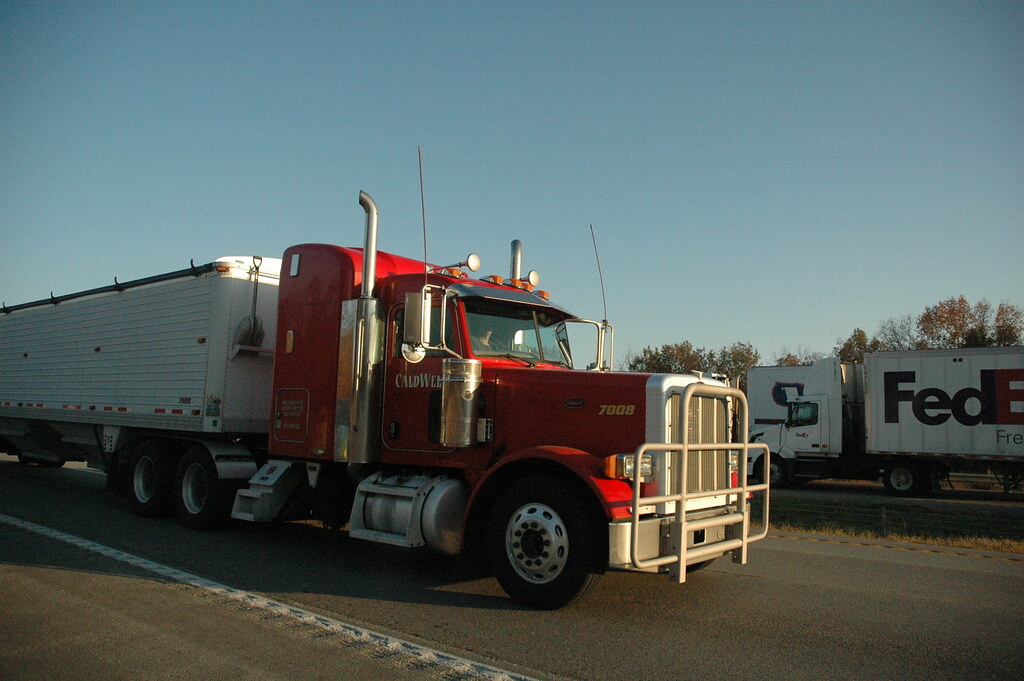
A semi-truck cannot turn right the way a car does. The rear trailer axles track inward on any turn, so the driver must swing the cab outward first - sometimes into a center lane - before sweeping the full rig to the right. A driver who does not know this can find themselves boxed in on the right side of a truck that is swinging directly across their path.
Watch for these signs before any truck turns right:
- The turn signal on both cab and trailer activates well before the intersection or driveway
- The truck slows and drifts center or left even though it will turn right
- Near port terminal driveways and industrial loading areas on I-595 service roads, a truck may need to use nearly the full road width to complete the turn
- At signalized intersections, the truck positions itself differently from a car - farther from the curb, not hugging it
The most dangerous response is squeezing past on the right while the cab is still swinging outward. The trailer closes that gap and you are inside the right-side No-Zone the entire time. If a truck signals right and drifts center, stop and give it the space to complete the turn. There is no safe way to pass it on the right at that moment.
The I-595 Port Corridor and Other High-Truck Broward Routes
I-595 carries the single heaviest concentration of commercial truck traffic in Broward County. It is the direct inland route from Port Everglades - connecting the port terminals at the east end of the highway to I-95 near downtown Fort Lauderdale, then continuing west to I-75 at the Sawgrass Expressway. Every container entering or leaving the port by truck uses some portion of it. Fuel tankers from the petroleum terminal add to that volume independently of container schedules, running throughout the day and overnight.
Other Broward routes carry significant truck traffic but at lower density:
- I-95 through Fort Lauderdale - the north-south spine for long-haul trucks coming from or continuing past I-595
- US-1 (Federal Highway) - slower surface route for local delivery and last-mile stops
- Broward Boulevard and SR-84 - industrial surface corridors connecting the port area to western distribution zones
- The Florida Turnpike - used by trucks moving through Broward north and south without entering the I-95 core
I-595 warrants the most preparation of any local road. On-ramps are short, lane-change activity peaks near the I-95 interchange, and loaded and empty trucks behave differently in traffic - a loaded drayage truck accelerates slowly from port gate stops, while an empty chassis on its return run handles with far more responsiveness. Both share lanes with cars moving at passenger-vehicle pace.
Underride Risk and Why You Should Never Linger Beside a Trailer
An underride crash happens when a passenger car slides beneath the body of a trailer rather than being pushed forward. The trailer floor is higher than most car rooflines. When a car contacts the side or rear of a trailer at speed, the result is not a standard collision - the trailer structure enters the passenger compartment at window height. From 2008 to 2017, underride crashes involving large trucks killed an average of 219 people annually in the United States, according to Government Accountability Office data.
Side underride is the specific risk for drivers who linger beside a trailer in traffic. It happens when a car drifts into a trailer's side - in stop-and-go conditions where speeds vary, when a truck changes lanes while a car sits in the right-side No-Zone, or at night when a dark trailer is not immediately visible. Rear underride happens when a following car cannot stop before striking the back of a trailer.
The practical rule is to pass completely or drop back and stay behind the truck with adequate following distance. Traveling at the same speed as a truck, positioned beside its trailer for an extended stretch, is the specific situation that creates side underride exposure. In slow I-595 traffic, you can end up beside a trailer without intending to be - the correct response is to ease off until you are clearly behind the truck, not beside it.
What to Do If a Truck Begins Merging Into Your Lane
This happens because the driver does not know you are there. You are in a No-Zone. The driver has checked the mirrors, seen what appeared to be a clear lane, and begun the merge. Your goal is to create separation without making anything worse.
Ease off the accelerator - do not brake hard unless you have confirmed nothing is close behind you. A hard brake while a truck comes over from the side risks a rear-end collision from whoever was following you. Controlled deceleration lets the truck pass ahead. Sound the horn once - a brief, clear signal to alert the driver - then stop. Leaning on the horn does not help. If the truck continues into your lane and there is shoulder space, a controlled steer toward it buys clearance. Never accelerate to try to get past a merging truck. If the truck is already alongside and still moving over, accelerating pushes you deeper into the merge path.
After the incident, move to a different lane and increase your following distance from any truck you approach. The situation resolved through your response. Do not assume the driver is now aware of where you are.
Frequently Asked Questions
Why do I see so many trucks on I-595 compared to other Broward highways?
I-595 is the direct inland route from Port Everglades, which handled more than 1.1 million shipping containers in fiscal year 2025. Every container leaving the port by truck uses I-595. The port also runs petroleum import terminals that generate separate tanker traffic around the clock. No other Broward highway carries that combination of container drayage and fuel distribution in one corridor.
How do I know when I am inside a truck's blind spot?
Use the driver's side mirror as your check. If you cannot see the truck driver's face reflected in the cab mirror, the driver cannot see you. On the right side, treat the entire lane beside and behind the trailer as a No-Zone by default. On the rear, if you are close enough that the side mirrors are no longer visible to you through your windshield, you are inside the rear blind spot.
Can trucks use the left lane on I-95 through Fort Lauderdale?
No. Florida law bans trucks with three or more axles from the left lane on I-95 for the entire segment between West Palm Beach and Miami, which covers Fort Lauderdale and all of Broward County. The same restriction applies on the Turnpike through Broward. Violations carry a minimum fine - visit the Florida Highway Safety and Motor Vehicles website for the current penalty amount, as the figure is subject to change.
How far ahead do I need to be before I pull back in after passing a semi-truck?
You need at least 10 car lengths - roughly 150 feet - between your rear bumper and the front of the truck before you move back into its lane. The visual check: both of the truck's headlights should be clearly visible in your rearview mirror. If you can only see part of the cab or no headlights yet, you have not cleared the front No-Zone.
What is an underride crash and why is it more dangerous than a normal collision?
An underride crash occurs when a car slides beneath the body of a trailer instead of making contact with its front or being pushed away. Because the trailer floor sits higher than most car rooflines, contact at speed can result in the trailer entering the car's passenger compartment. Underride crashes averaged 219 deaths per year over a recent ten-year period in the United States. Avoiding them comes down to one habit: do not linger beside a trailer, and maintain enough following distance to stop before you reach a truck's rear.
Should new drivers avoid I-595 until they have more experience?
Avoiding it is not a realistic option in Fort Lauderdale, and skipping it denies you practice on the road you will use regularly. Better preparation is more useful than avoidance. Know that I-595 carries heavier truck traffic than most Broward roads, plan every lane change earlier than you would around passenger vehicles, pass trucks on the left only, and give yourself more following distance. Those habits make the road manageable rather than something to work around indefinitely.
```